


Software development has evolved dramatically over the past decade. Modern businesses are expected to release new features quickly, respond to customer feedback faster, and maintain application reliability without compromising security or quality. However, traditional software delivery methods often rely on manual testing, delayed deployments, and siloed teams, making it difficult to meet today’s business expectations.
This is where Continuous Integration (CI) and Continuous Deployment (CD) become essential. As core practices of DevOps, CI/CD automates the software delivery lifecycle—from code integration and testing to deployment and monitoring—allowing organizations to release software faster, reduce deployment risks, and improve collaboration across development and operations teams.
Whether you’re developing cloud-native applications, modernizing legacy systems, or scaling enterprise DevOps practices, implementing a robust CI/CD pipeline can significantly improve productivity and software quality. Organizations looking to accelerate software delivery often rely on DevOps services to design, implement, and optimize CI/CD pipelines that align with business objectives.
In this guide, we’ll explore the benefits of CI/CD, implementation best practices, common challenges, and how organizations can successfully adopt CI/CD to accelerate digital transformation.
What is CI/CD in DevOps?
Continuous Integration (CI) and Continuous Deployment (CD) are two complementary practices that automate the process of building, testing, and delivering software. Together, they form the foundation of modern DevOps by enabling development teams to release software faster while maintaining high quality and reliability.
Continuous Integration (CI)
Continuous Integration is the practice of integrating code changes from multiple developers into a shared repository several times a day. Every code commit automatically triggers a series of validation steps, including code compilation, automated testing, and quality checks.
By validating changes early, Continuous Integration helps teams:
- Detect bugs before they reach production
- Reduce merge conflicts
- Improve code quality
- Accelerate feature development
- Increase collaboration across development teams
Continuous Deployment (CD)
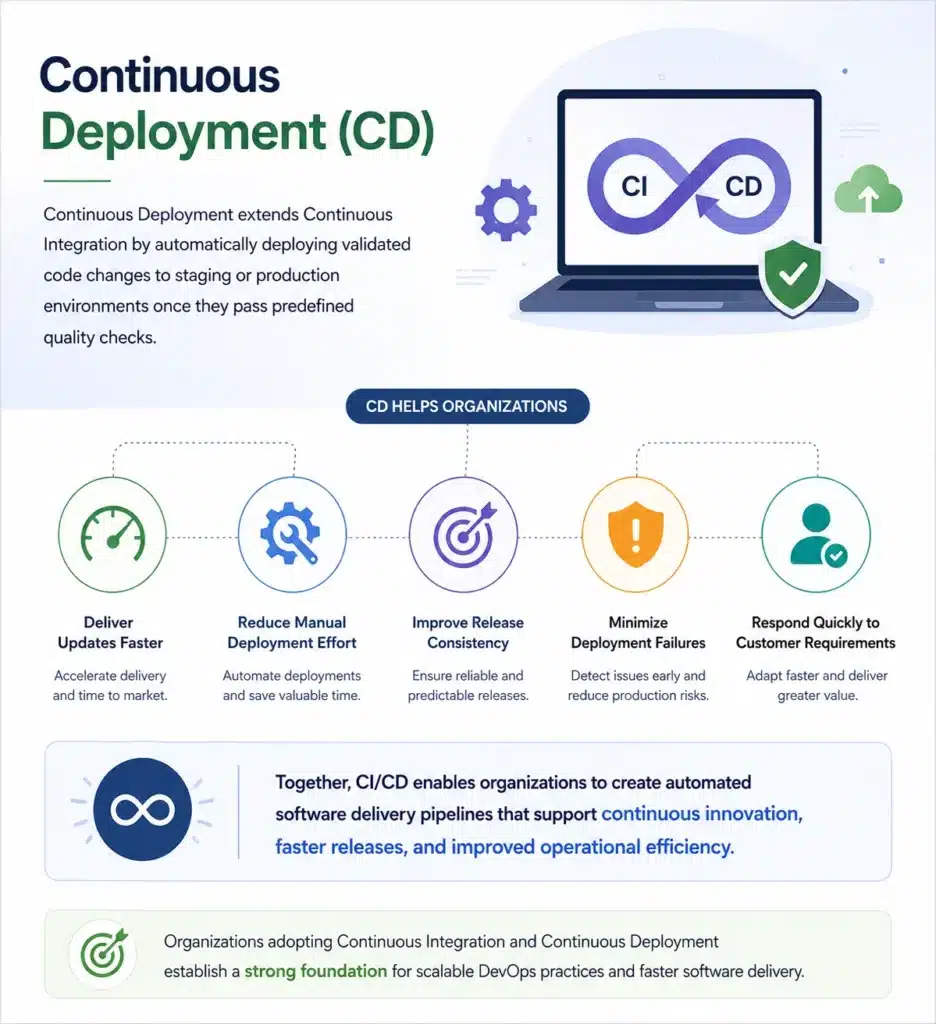
Continuous Deployment extends Continuous Integration by automatically deploying validated code changes to staging or production environments once they pass predefined quality checks.
Continuous Deployment helps organizations:
- Deliver software updates faster
- Reduce manual deployment effort
- Improve release consistency
- Minimize deployment failures
- Respond quickly to customer requirements
Together, CI/CD enables organizations to create automated software delivery pipelines that support continuous innovation, faster releases, and improved operational efficiency.
Organizations adopting Continuous Integration and Continuous Deployment establish a strong foundation for scalable DevOps practices and faster software delivery.
Why CI/CD Matters in Modern DevOps
Modern software development extends beyond writing code. Development teams must also manage testing, security, infrastructure, deployment, monitoring, and ongoing maintenance. Without automation, these activities become time-consuming, error-prone, and difficult to scale.
CI/CD eliminates many of these challenges by automating repetitive development processes and creating a standardized software delivery workflow.
Organizations implementing mature CI/CD practices typically achieve:
- Faster release cycles
- Reduced deployment failures
- Higher software quality
- Improved collaboration between development and operations teams
- Faster recovery from production incidents
- Increased deployment frequency
- Better customer experiences
- Lower operational costs
As organizations embrace digital transformation, CI/CD has become one of the most important capabilities for building reliable, scalable software delivery pipelines.
Businesses implementing a DevOps implementation strategy often begin with CI/CD because it creates the automation foundation needed for continuous software delivery.
Benefits of CI/CD in DevOps
Implementing CI/CD delivers measurable improvements throughout the software development lifecycle.
Faster Time-to-Market
Automated build, testing, and deployment pipelines significantly reduce release cycles, allowing organizations to deliver new features, updates, and bug fixes much faster. This enables businesses to respond quickly to changing customer expectations and market demands.
Early Bug Detection
Continuous testing validates every code change before deployment, helping teams identify defects early in the development process. Early bug detection reduces production issues, lowers maintenance costs, and improves application stability.
Improved Team Collaboration
CI/CD provides a shared workflow where developers, testers, operations teams, and security professionals collaborate through automated pipelines and centralized visibility. This improves communication while reducing delays caused by manual handoffs.
Organizations implementing DevOps automation best practices often improve collaboration by eliminating repetitive tasks and enabling teams to focus on innovation.
Enhanced Software Quality
Automated testing, code reviews, and quality gates ensure that every code change meets predefined quality standards before deployment. This reduces human error while improving application reliability and maintainability.
Increased Deployment Reliability
Standardized deployment workflows reduce inconsistencies across development, testing, and production environments. Automated rollback mechanisms further minimize downtime during software releases.
Greater Business Agility
With faster deployments and continuous feedback, organizations can innovate more rapidly, respond to customer needs faster, and remain competitive in rapidly changing markets.
Core Components of a CI/CD Pipeline
A successful CI/CD pipeline consists of multiple automated stages that work together to deliver reliable software.
| Pipeline Stage | Purpose |
| Source Code Management | Store and manage application code using Git repositories. |
| Continuous Integration | Automatically build and validate every code change. |
| Automated Testing | Execute unit, integration, regression, and security tests. |
| Artifact Management | Store build packages and versioned releases. |
| Continuous Deployment | Deploy validated applications automatically across environments. |
| Monitoring & Feedback | Monitor application health and gather deployment insights. |
Organizations seeking to improve release speed should continuously focus on optimizing CI/CD pipelines by reducing build times, improving automation, and streamlining deployment workflows.
Best Practices for Implementing CI/CD in DevOps
Successfully implementing CI/CD requires more than adopting automation tools—it demands a well-defined strategy, standardized workflows, and a culture of continuous improvement. By following proven best practices, organizations can maximize the benefits of CI/CD while minimizing deployment risks and improving software quality.
1. Build a Strong Version Control Strategy
Every successful CI/CD pipeline starts with an effective version control system. Platforms like Git enable development teams to collaborate efficiently by tracking every code change, maintaining version history, and supporting parallel development through branching strategies.
Implementing workflows such as GitFlow or trunk-based development helps reduce merge conflicts while improving release management and code stability.
A well-managed version control process becomes even more effective when integrated into a structured DevOps pipeline that automates every stage of software delivery.
2. Automate Build and Deployment Processes
Manual builds often introduce inconsistencies and slow down software releases. Automating build processes ensures that every code commit is compiled, validated, packaged, and prepared for deployment without manual intervention.
Modern CI/CD platforms support automated workflows that:
- Trigger builds automatically
- Validate code quality
- Generate deployment artifacts
- Notify teams of failures
- Accelerate software releases
Organizations should continuously review and improve build performance to eliminate bottlenecks and maintain efficient delivery pipelines.
3. Integrate Continuous Testing Throughout the Pipeline
Testing should never be treated as the final step before deployment. Instead, quality assurance should be embedded throughout the software development lifecycle.
An effective CI/CD pipeline includes:
- Unit Testing
- Integration Testing
- Functional Testing
- Regression Testing
- Performance Testing
- Security Testing
Continuous testing provides immediate feedback to developers, enabling faster bug fixes and reducing the risk of production failures.
Teams looking to improve overall software quality should also explore quality assurance strategies in software development to strengthen testing processes beyond automated pipelines.
4. Manage Build Artifacts Efficiently
A centralized artifact repository stores compiled applications, libraries, and dependencies, ensuring that every deployment uses approved and version-controlled packages.
Artifact repositories help organizations:
- Improve deployment consistency
- Simplify rollback procedures
- Manage software dependencies
- Support regulatory compliance
- Improve release traceability
Combined with automated pipelines, artifact management improves deployment reliability across multiple environments.
5. Adopt Infrastructure as Code (IaC)
Infrastructure provisioning should be automated just like application deployment.
Infrastructure as Code (IaC) enables teams to define servers, networking, storage, and cloud resources using code instead of manual configuration.
Benefits include:
- Consistent infrastructure
- Faster environment provisioning
- Easier disaster recovery
- Reduced configuration drift
- Improved scalability
Organizations migrating workloads to cloud platforms often combine IaC with cloud migration using DevOps to automate infrastructure deployment while improving operational efficiency.
6. Standardize Containerization and Orchestration
Containerization has become a standard practice for modern software development because it ensures applications behave consistently across development, testing, and production environments.
Technologies like Docker and Kubernetes simplify deployment by providing:
- Consistent runtime environments
- Automated scaling
- High availability
- Self-healing infrastructure
- Simplified deployment management
Organizations adopting cloud-native development should understand containerization and orchestration with Docker and Kubernetes to build scalable deployment pipelines.
Common Challenges in CI/CD Implementation
While CI/CD delivers significant business value, implementation often presents several challenges that organizations must address.
Managing Legacy Applications
Legacy systems frequently lack the architecture needed for automated testing and deployment.
Organizations modernizing legacy applications should gradually introduce automation while maintaining business continuity.
Scaling CI/CD Pipelines
As development teams grow, pipelines become increasingly complex.
Common scaling challenges include:
- Longer build times
- Increased infrastructure costs
- Complex deployment workflows
- Environment inconsistencies
Regular pipeline optimization and automation help maintain performance as software delivery scales.
Maintaining Security Throughout the Pipeline

Security should be integrated into every phase of the CI/CD process rather than treated as a final checkpoint.
Modern organizations increasingly adopt DevSecOps practices by integrating:
- Vulnerability scanning
- Secrets management
- Dependency analysis
- Compliance validation
- Automated security testing
Teams implementing secure pipelines should understand how DevSecOps works and how security automation strengthens software delivery.
Monitoring and Continuous Feedback
CI/CD doesn’t end after deployment.
Continuous monitoring enables teams to measure:
- Application availability
- Deployment success rates
- Infrastructure utilization
- Performance bottlenecks
- User experience
By collecting real-time operational data, organizations can continuously improve both application quality and deployment efficiency.
Development teams implementing mature DevOps practices should also address common DevOps challenges that affect long-term software delivery performance.
Why Choose MicroGenesis for CI/CD Implementation?
Implementing CI/CD successfully involves much more than automating builds and deployments. Organizations need a strategic approach that aligns technology, people, and processes to achieve faster software delivery while maintaining security, compliance, and quality.
MicroGenesis brings decades of experience helping organizations modernize software delivery through DevOps consulting, cloud transformation, and automation solutions. Our experts design scalable CI/CD pipelines that seamlessly integrate development, testing, deployment, and monitoring into a unified workflow.
Whether you’re modernizing legacy applications, adopting cloud-native architectures, or building enterprise DevOps capabilities, MicroGenesis helps reduce implementation complexity while accelerating business outcomes.
Our CI/CD services include:
- DevOps strategy and roadmap development
- CI/CD pipeline design and implementation
- Build and release automation
- Infrastructure as Code (IaC)
- Cloud and hybrid deployment automation
- DevSecOps integration
- Pipeline optimization and continuous improvement
Organizations looking to build a mature DevOps ecosystem can also explore DevOps benefits and implementation strategies to understand how automation improves operational efficiency and software quality.
Future Trends in CI/CD
CI/CD continues to evolve alongside modern software engineering practices. Organizations are increasingly adopting intelligent automation to improve software delivery while maintaining security and scalability.
Some of the key trends shaping CI/CD include:
AI-Assisted DevOps
Artificial intelligence is being used to predict build failures, identify deployment risks, optimize testing, and improve pipeline efficiency.
GitOps
GitOps enables infrastructure and application deployments using Git repositories as the single source of truth, improving consistency and auditability.
Platform Engineering
Internal developer platforms are simplifying CI/CD by providing reusable templates, standardized environments, and self-service deployment capabilities.
Cloud-Native Development
Organizations continue moving toward Kubernetes, containers, and serverless architectures to improve scalability and resilience.
Businesses embracing cloud-native software delivery should understand how cloud computing enhances DevOps practices to fully leverage automation and scalable infrastructure.
Conclusion
Continuous Integration and Continuous Deployment have become fundamental components of modern DevOps practices. By automating code integration, testing, deployment, and monitoring, CI/CD enables organizations to deliver software faster, improve collaboration, reduce operational risks, and maintain high application quality.
However, implementing CI/CD successfully requires more than adopting automation tools. It demands standardized workflows, continuous testing, infrastructure automation, security integration, and a culture focused on continuous improvement.
Whether your organization is beginning its DevOps journey or optimizing an existing software delivery pipeline, investing in the right strategy, tools, and expertise can significantly improve long-term business outcomes.
For organizations planning to scale software delivery even further, understanding DevOps best practices can help establish a strong foundation for continuous innovation and operational excellence.
Ready to Accelerate Your DevOps Journey?
Modern software delivery requires more than just faster deployments—it requires a scalable, secure, and automated development ecosystem.
MicroGenesis helps organizations implement enterprise-grade CI/CD pipelines, modernize DevOps practices, and optimize software delivery through proven automation strategies, cloud-native technologies, and industry best practices.
Whether you’re building a new CI/CD pipeline or enhancing an existing DevOps environment, our experts can help you streamline development workflows, improve software quality, and accelerate digital transformation.
Get in touch with MicroGenesis today to build a smarter, faster, and more resilient software delivery pipeline.


