


Modern software delivery is no longer measured only by how quickly applications are released. Organizations must also ensure reliability, security, scalability, and operational efficiency while meeting growing customer expectations. In today’s cloud-first world, where businesses deploy software multiple times a day, DevOps has become a strategic capability rather than simply an IT methodology.
However, adopting DevOps tools alone doesn’t guarantee success.
Many organizations invest heavily in CI/CD platforms, cloud infrastructure, containers, and automation, yet continue to experience deployment failures, service outages, rising cloud costs, and frustrated engineering teams. The root cause is often not the technology itself—but poor DevOps practices.
Poorly implemented DevOps introduces hidden costs that rarely appear in IT budgets but significantly impact business performance. These costs include reduced productivity, infrastructure waste, security vulnerabilities, delayed product releases, customer dissatisfaction, and lost competitive opportunities.
Organizations planning enterprise-wide adoption should first understand DevOps implementation strategy to build a strong foundation that aligns people, processes, and technology.
In this guide, we’ll uncover the hidden costs of ineffective DevOps practices, explain how they impact business growth, and share practical strategies to help organizations build resilient, scalable, and cost-effective DevOps environments.
Why Poor DevOps Is More Expensive Than Most Organizations Realize
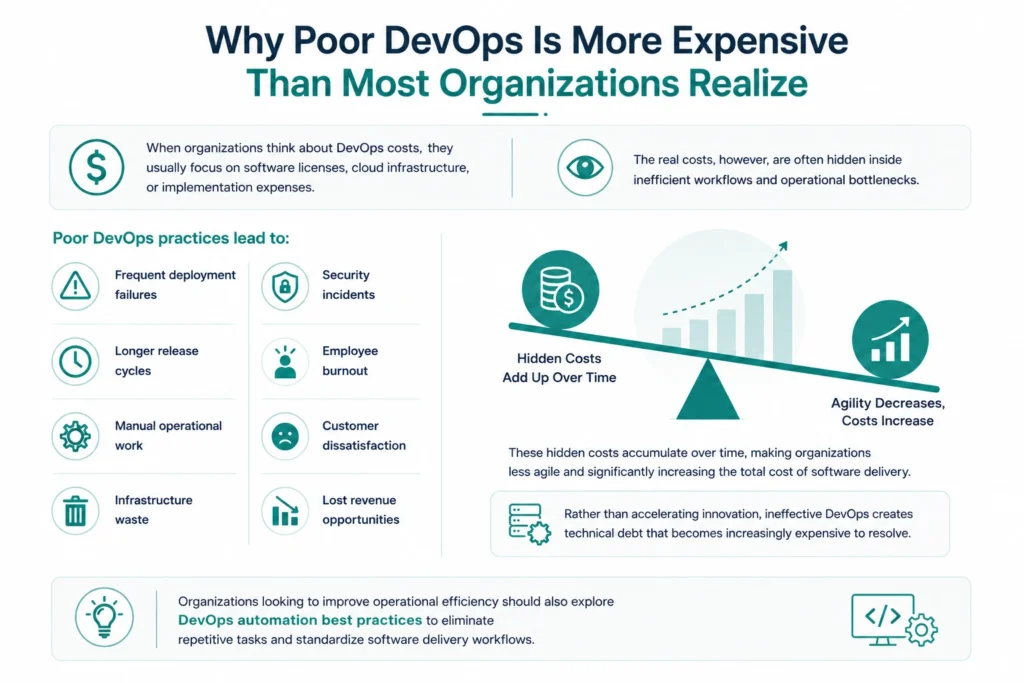
When organizations think about DevOps costs, they usually focus on software licenses, cloud infrastructure, or implementation expenses.
The real costs, however, are often hidden inside inefficient workflows and operational bottlenecks.
Poor DevOps practices lead to:
- Frequent deployment failures
- Longer release cycles
- Manual operational work
- Infrastructure waste
- Security incidents
- Employee burnout
- Customer dissatisfaction
- Lost revenue opportunities
These hidden costs accumulate over time, making organizations less agile and significantly increasing the total cost of software delivery.
Rather than accelerating innovation, ineffective DevOps creates technical debt that becomes increasingly expensive to resolve.
Organizations looking to improve operational efficiency should also explore DevOps automation best practices to eliminate repetitive tasks and standardize software delivery workflows.
What Happens When DevOps Is Poorly Implemented?
Many organizations begin their DevOps journey by purchasing automation tools without addressing the cultural, operational, and process changes required for long-term success.
As a result, they automate inefficient workflows instead of improving them.
Common signs of poor DevOps implementation include:
- Manual deployments
- Inconsistent environments
- Limited collaboration between teams
- Slow incident response
- Lack of deployment automation
- Poor monitoring and observability
- Weak security practices
- Limited documentation
- Siloed development and operations teams
- Difficulty scaling cloud infrastructure
Instead of reducing operational complexity, these issues create additional bottlenecks that slow software delivery and increase business risk.
Early Warning Signs Your DevOps Strategy Needs Attention
Organizations often experience several warning signs long before major failures occur.
Watch for these indicators:
| Warning Sign | Business Impact |
| Frequent production issues | Reduced customer trust |
| Slow deployments | Delayed product releases |
| Manual release processes | Higher operational costs |
| Long recovery times | Increased downtime |
| Growing cloud expenses | Reduced ROI |
| Repeated security issues | Compliance risks |
| Developer frustration | Lower productivity |
| Lack of automation | Increased human error |
Recognizing these symptoms early enables organizations to address underlying problems before they become costly business issues.
Hidden Cost #1: Increased Downtime and Business Disruption
Every minute of application downtime impacts revenue, customer satisfaction, and business reputation.
Without mature DevOps practices, organizations often struggle with:
- Failed deployments
- Configuration errors
- Infrastructure failures
- Slow incident response
- Limited rollback capabilities
Even small deployment mistakes can trigger widespread service disruptions.
For customer-facing applications, downtime often results in:
- Lost transactions
- Reduced customer confidence
- SLA violations
- Brand damage
- Emergency operational costs
The financial impact extends far beyond IT, affecting sales, customer support, marketing, and overall business performance.
How Mature DevOps Reduces Downtime
Successful DevOps organizations minimize outages through:
✔ Automated deployments
✔ Infrastructure as Code (IaC)
✔ Continuous monitoring
✔ Automated rollback strategies
✔ High-availability architectures
✔ Continuous testing
These practices significantly reduce deployment risk while improving overall system reliability.
Organizations strengthening release reliability should also understand Continuous Integration and Continuous Deployment (CI/CD) and how automated pipelines reduce deployment failures.
Hidden Cost #2: Rising Operational Expenses
Manual operational processes consume valuable engineering time.
Instead of developing new products, technical teams spend countless hours:
- Fixing deployment failures
- Managing infrastructure manually
- Troubleshooting recurring issues
- Reconfiguring environments
- Performing repetitive administrative tasks
These inefficiencies increase operational costs while reducing overall engineering productivity.
As businesses scale, manual operations become increasingly expensive.
Where Operational Costs Increase
Common sources include:
- Manual software deployments
- Repeated incident management
- Infrastructure maintenance
- Emergency troubleshooting
- Duplicate operational tasks
- Environment inconsistencies
Without automation, organizations often need larger operations teams simply to maintain existing systems.
Why Automation Matters
Automation enables organizations to:
- Reduce manual effort
- Standardize deployments
- Improve deployment consistency
- Eliminate repetitive tasks
- Increase engineering productivity
Instead of spending time maintaining infrastructure, teams focus on innovation and customer value.
Hidden Cost #3: Slower Time-to-Market
In today’s competitive markets, speed is a strategic advantage.
Organizations that deliver new features faster respond more quickly to customer demands and changing market conditions.
Poor DevOps practices slow software delivery through:
- Manual approvals
- Long testing cycles
- Deployment bottlenecks
- Infrastructure delays
- Inconsistent environments
These delays often allow competitors to introduce new capabilities first.
Business Consequences
Slow software delivery impacts:
- Revenue growth
- Customer acquisition
- Product innovation
- Market competitiveness
- Business agility
Organizations unable to release software quickly often struggle to keep pace with rapidly evolving customer expectations.
Businesses seeking faster software delivery should also evaluate CI/CD tools for DevOps teams to automate releases and improve deployment efficiency.
The Business Value of Investing in Better DevOps
Organizations that strengthen their DevOps practices consistently achieve:
- Faster release cycles
- Reduced downtime
- Improved software quality
- Lower operational costs
- Better collaboration
- Higher customer satisfaction
- Greater business agility
Rather than viewing DevOps as an IT initiative, successful organizations recognize it as a strategic business capability that directly influences growth, innovation, and long-term competitiveness.
Hidden Cost #4: Employee Burnout and Reduced Productivity
People are at the heart of every successful DevOps initiative. However, when DevOps practices are poorly implemented, engineering teams often bear the burden of inefficient processes, manual deployments, recurring production issues, and constant firefighting.
Instead of focusing on innovation and product development, developers and operations engineers spend valuable time resolving avoidable incidents.
Over time, this creates:
- Increased stress and fatigue
- Reduced employee engagement
- Higher staff turnover
- Lower engineering productivity
- Difficulty attracting top talent
In today’s competitive technology landscape, retaining skilled engineers is just as important as adopting the right tools.
Common Causes of Burnout
Organizations frequently experience burnout due to:
- Repetitive manual deployments
- Late-night production releases
- Frequent emergency incidents
- Poor documentation
- Lack of automation
- Unclear ownership
- Continuous context switching
These challenges reduce employee satisfaction while increasing operational costs.
How Mature DevOps Improves Developer Experience
Successful DevOps organizations improve productivity by:
✔ Automating repetitive tasks
✔ Implementing self-service infrastructure
✔ Improving documentation
✔ Standardizing deployment workflows
✔ Encouraging collaboration
✔ Reducing unnecessary approvals
By removing operational friction, engineering teams can spend more time building products instead of maintaining processes.
Hidden Cost #5: Security Vulnerabilities and Compliance Risks
Security can no longer be treated as the final step before production.
Modern software releases happen frequently, often multiple times per day. Without integrating security into the development lifecycle, organizations significantly increase the risk of vulnerabilities reaching production.
Common security challenges include:
- Hardcoded credentials
- Unpatched dependencies
- Misconfigured cloud resources
- Weak identity management
- Unsecured APIs
- Container vulnerabilities
- Compliance violations
A single security incident can lead to:
- Financial penalties
- Regulatory violations
- Customer data loss
- Brand reputation damage
- Legal consequences
Build Security into Every Deployment
Rather than performing manual security reviews late in development, organizations should adopt DevSecOps practices that automate security throughout the CI/CD pipeline.
Key practices include:
- Automated vulnerability scanning
- Static code analysis
- Dependency scanning
- Secrets management
- Container image scanning
- Compliance validation
Security becomes everyone’s responsibility—not just the security team’s.
Organizations strengthening software security should also understand What is DevSecOps? and how security integrates seamlessly into modern software delivery pipelines.
Hidden Cost #6: Wasted Cloud Infrastructure Spending
Cloud platforms provide incredible flexibility, but without effective DevOps governance, they can also become a major source of unnecessary spending.
Many organizations unknowingly pay for:
- Idle virtual machines
- Oversized infrastructure
- Unused storage
- Duplicate environments
- Forgotten development resources
- Over-provisioned Kubernetes clusters
As organizations scale, these inefficiencies significantly increase monthly cloud costs.
Common Causes of Cloud Waste
Cloud spending often increases because of:
| Poor Practice | Business Impact |
| Manual infrastructure provisioning | Resource duplication |
| No Infrastructure as Code | Configuration inconsistencies |
| Idle development environments | Unnecessary cloud bills |
| Lack of auto-scaling | Higher infrastructure costs |
| Poor resource tagging | Limited cost visibility |
| No governance policies | Budget overruns |
Without proper visibility, businesses continue paying for resources that provide little or no value.
Optimize Infrastructure Through DevOps
Modern DevOps practices help organizations reduce cloud costs by:
- Automating infrastructure provisioning
- Implementing Infrastructure as Code (IaC)
- Enabling auto-scaling
- Removing unused resources
- Monitoring infrastructure utilization
- Applying governance policies
Automation not only improves efficiency but also ensures organizations pay only for the resources they actually need.
Businesses modernizing their infrastructure should also explore Migrating to the Cloud with DevOps to understand how automation simplifies cloud adoption while controlling costs.
Hidden Cost #7: Poor Customer Experience and Lost Revenue
Customers rarely notice when software is working perfectly.
They immediately notice when it isn’t.
Poor DevOps practices often result in:
- Slow application performance
- Failed releases
- Extended downtime
- Broken features
- Delayed product updates
- Inconsistent user experiences
Even minor service disruptions can have a significant impact on customer trust and long-term business growth.
Customer Expectations Continue to Rise
Today’s users expect:
- Fast application performance
- Reliable availability
- Frequent feature updates
- Secure digital experiences
- Minimal service interruptions
Organizations unable to meet these expectations often lose customers to competitors offering more reliable digital services.
DevOps Directly Impacts Customer Satisfaction
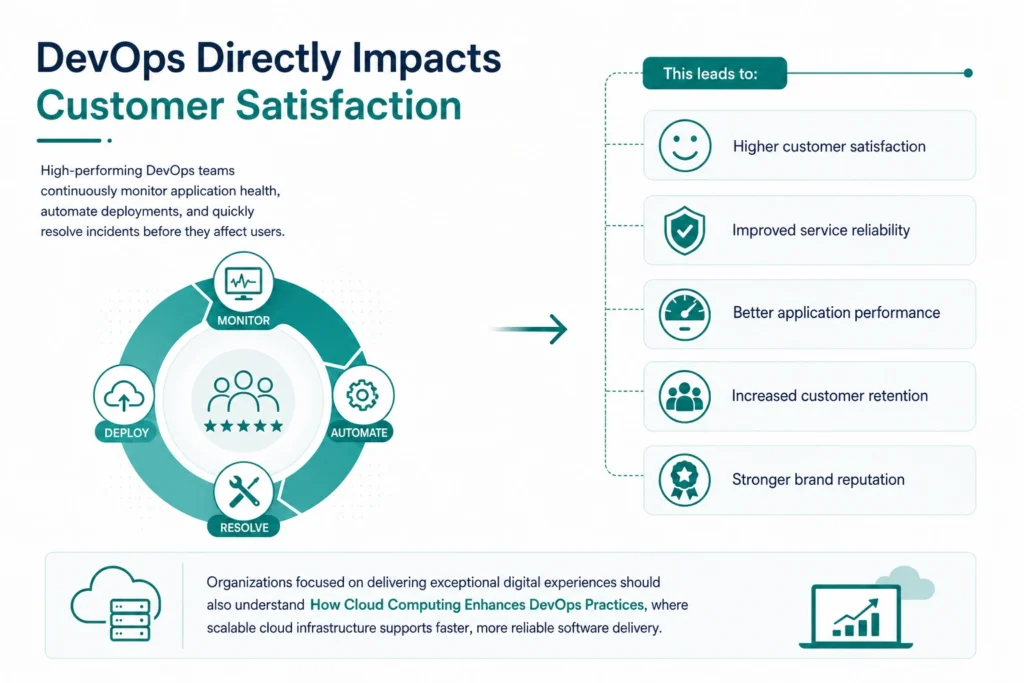
High-performing DevOps teams continuously monitor application health, automate deployments, and quickly resolve incidents before they affect users.
This leads to:
✔ Higher customer satisfaction
✔ Improved service reliability
✔ Better application performance
✔ Increased customer retention
✔ Stronger brand reputation
Organizations focused on delivering exceptional digital experiences should also understand How Cloud Computing Enhances DevOps Practices, where scalable cloud infrastructure supports faster, more reliable software delivery.
Real-World Impact of Poor DevOps Practices
The consequences of ineffective DevOps extend far beyond technical challenges.
Organizations commonly experience:
| Business Challenge | Long-Term Impact |
| Frequent outages | Lost customer trust |
| Slow software releases | Reduced competitiveness |
| Manual operations | Higher operational costs |
| Security incidents | Compliance penalties |
| Employee burnout | Increased turnover |
| Cloud resource waste | Reduced profitability |
| Poor customer experience | Lower customer retention |
These issues often compound over time, making future modernization efforts even more expensive and complex.
Organizations that address DevOps challenges early are better positioned to build resilient, scalable, and cost-efficient software delivery practices.
Businesses facing operational complexity should also explore Challenges in Cloud and DevOps Integration to understand common obstacles and proven strategies for overcoming them.
How to Avoid the Hidden Costs of Poor DevOps Practices
Avoiding costly DevOps mistakes requires more than adopting modern tools—it demands a strategic approach that combines automation, collaboration, governance, and continuous improvement. Organizations that proactively strengthen their DevOps practices are better positioned to reduce operational costs, improve software quality, and accelerate innovation.
Below are the key strategies that help build a resilient and cost-effective DevOps ecosystem.
1. Build a DevOps-First Culture
Technology alone cannot fix disconnected teams or inefficient workflows.
A successful DevOps transformation begins by fostering collaboration between development, operations, QA, security, and business stakeholders. Everyone should work toward shared business goals rather than isolated departmental objectives.
Organizations should encourage:
- Shared ownership of applications
- Cross-functional collaboration
- Continuous knowledge sharing
- Blameless post-incident reviews
- Regular feedback sessions
- Transparent communication
A strong DevOps culture reduces operational friction while improving innovation across the organization.
2. Invest in End-to-End Automation
Manual processes introduce delays, inconsistencies, and unnecessary risks.
Organizations should automate every stage of the software delivery lifecycle wherever possible.
Key automation opportunities include:
✔ Code integration
✔ Automated testing
✔ Infrastructure provisioning
✔ Security validation
✔ Application deployment
✔ Monitoring and alerting
✔ Incident response
Automation allows engineering teams to focus on solving business problems rather than performing repetitive operational tasks.
3. Implement Infrastructure as Code (IaC)
Managing infrastructure manually becomes increasingly difficult as organizations grow.
Infrastructure as Code enables teams to provision, configure, and manage environments using version-controlled code instead of manual processes.
Benefits include:
- Consistent environments
- Faster provisioning
- Easier disaster recovery
- Improved compliance
- Reduced configuration drift
- Better scalability
By treating infrastructure like application code, organizations gain greater reliability while reducing operational complexity.
4. Strengthen Monitoring and Observability
You cannot improve what you cannot measure.
Modern DevOps organizations implement comprehensive observability across applications, infrastructure, cloud platforms, containers, and Kubernetes environments.
An effective monitoring strategy should include:
- Real-time dashboards
- Performance metrics
- Centralized logging
- Distributed tracing
- Intelligent alerting
- Root cause analysis
Proactive monitoring enables teams to identify issues before they impact customers.
5. Measure DevOps Performance Using DORA Metrics
High-performing organizations continuously evaluate the effectiveness of their DevOps initiatives.
The industry-standard DORA metrics provide valuable insights into software delivery performance.
| Metric | Why It Matters |
| Deployment Frequency | Measures delivery speed |
| Lead Time for Changes | Evaluates development efficiency |
| Change Failure Rate | Indicates release quality |
| Mean Time to Recovery (MTTR) | Measures operational resilience |
Tracking these metrics helps organizations identify bottlenecks and continuously improve software delivery.
6. Embed Security Throughout the Development Lifecycle
Security should never slow innovation—it should enable it.
Modern organizations adopt DevSecOps practices that integrate security into every stage of the CI/CD pipeline.
Best practices include:
- Automated vulnerability scanning
- Dependency management
- Static application security testing (SAST)
- Dynamic application security testing (DAST)
- Secrets management
- Compliance validation
Embedding security early reduces risks while maintaining delivery speed.
7. Continuously Optimize Cloud Resources
Cloud infrastructure offers incredible scalability, but without governance it can quickly become expensive.
Organizations should regularly review:
- Idle virtual machines
- Kubernetes clusters
- Storage utilization
- Network usage
- Reserved instances
- Auto-scaling policies
Implementing cloud governance and FinOps practices helps maximize cloud ROI while preventing unnecessary spending.
Future Trends That Will Shape DevOps Beyond 2026
As software delivery continues to evolve, several emerging technologies are transforming DevOps practices.
Organizations investing today should prepare for:
AI-Powered DevOps (AIOps)
Artificial Intelligence helps engineering teams:
- Predict infrastructure failures
- Detect anomalies
- Automate incident response
- Optimize deployments
- Improve monitoring
Businesses preparing for intelligent IT operations should also explore Artificial Intelligence for IT Operations (AIOps) to understand how AI is reshaping modern DevOps environments.
Platform Engineering
Internal Developer Platforms (IDPs) simplify software delivery by providing developers with standardized tools, self-service infrastructure, and automated workflows.
Platform engineering is rapidly becoming the foundation of enterprise-scale DevOps.
GitOps
GitOps enables infrastructure and application deployments directly from Git repositories, improving consistency, security, and auditability while simplifying change management.
Intelligent Cloud Operations
Cloud platforms increasingly use AI and automation to optimize:
- Resource allocation
- Cost management
- Security monitoring
- Infrastructure scaling
- Performance optimization
These capabilities help organizations operate more efficiently while reducing manual intervention.
Why Choose MicroGenesis for DevOps Transformation?
Avoiding the hidden costs of poor DevOps practices requires more than implementing automation tools. It requires a strategic transformation that aligns people, processes, cloud infrastructure, security, and business objectives into a modern software delivery model.
MicroGenesis helps organizations modernize their DevOps consulting services capabilities through consulting, implementation, automation, and managed services tailored to enterprise needs. Our experts work closely with businesses to streamline software delivery, improve collaboration, strengthen security, and optimize cloud operations while minimizing operational risks.
Our DevOps expertise includes:
- DevOps Consulting and Assessment
- Enterprise DevOps Transformation
- CI/CD Pipeline Implementation
- Infrastructure as Code (IaC)
- Cloud Migration and Modernization
- Kubernetes and Container Orchestration
- DevSecOps Implementation
- DevOps Automation
- Managed DevOps Services
Whether you’re modernizing legacy systems or building cloud-native applications, MicroGenesis helps you accelerate innovation while improving software quality, operational efficiency, and business agility.
Conclusion
The true cost of poor DevOps practices extends far beyond delayed deployments or inefficient workflows. It impacts business agility, customer satisfaction, employee productivity, cloud spending, security, and long-term growth. Organizations that overlook these hidden costs often struggle with recurring operational challenges that become increasingly expensive to resolve over time.
Building a mature DevOps practice requires a balanced focus on people, processes, automation, and continuous improvement. By fostering collaboration, embracing automation, implementing Infrastructure as Code, integrating security throughout the development lifecycle, and leveraging data-driven insights, businesses can reduce operational risks while delivering software faster and more reliably.
As digital transformation accelerates in 2026 and beyond, organizations that invest in modern DevOps practices will be better equipped to innovate, scale efficiently, and maintain a competitive advantage. With MicroGenesis as your trusted DevOps transformation partner, you can eliminate hidden operational costs, strengthen software delivery capabilities, and build a resilient, future-ready technology ecosystem that supports sustainable business growth.


