


In today’s hypercompetitive digital economy, organizations are under constant pressure to do more with less. Customers expect instant responses, employees demand better digital tools, regulations continue to evolve, and businesses are expected to innovate faster than ever before. At the same time, operational costs continue to rise, making efficiency and agility critical to long-term success.
To meet these demands, organizations are increasingly investing in automation. While Robotic Process Automation (RPA) has helped businesses automate repetitive, rule-based tasks, modern enterprises require something more powerful—automation that can learn, analyze, and make intelligent decisions.
This is where the combination of Artificial Intelligence (AI) and Robotic Process Automation (RPA) is transforming industries.
Together, AI and RPA create Intelligent Automation, enabling businesses to automate not only repetitive processes but also complex, data-driven workflows that traditionally required human judgment. From processing invoices and detecting fraud to predicting customer behavior and optimizing supply chains, Intelligent Automation is helping organizations improve efficiency, reduce costs, and unlock entirely new opportunities for growth.
Across industries such as banking, healthcare, manufacturing, retail, insurance, and logistics, businesses are rapidly adopting Intelligent Automation to streamline operations, improve customer experiences, and scale without significantly increasing operational costs. The growing adoption of Robotic Process Automation in India further reflects how enterprises are embracing automation to stay competitive in an increasingly digital marketplace.
In this comprehensive guide, we’ll explore how AI and RPA work together, why Intelligent Automation has become essential for business growth, real-world industry applications, implementation best practices, and how partnering with an experienced RPA consulting services provider can accelerate your digital transformation journey.
Why Traditional Automation Is No Longer Enough
For years, Robotic Process Automation has delivered impressive results by eliminating repetitive manual work.
Organizations have successfully automated processes such as:
- Invoice processing
- Employee onboarding
- Payroll operations
- Data migration
- Report generation
- Claims processing
- Customer onboarding
These initiatives have helped businesses:
- Reduce operational costs
- Improve process accuracy
- Minimize manual errors
- Increase employee productivity
- Accelerate turnaround times
However, today’s business environment has changed dramatically.
Modern enterprises deal with:
- Millions of customer interactions
- Massive volumes of structured and unstructured data
- Constant regulatory changes
- Multi-channel customer communication
- Increasing cybersecurity risks
- Growing operational complexity
Traditional automation struggles when processes require interpretation, decision-making, or continuous learning.
For example, an RPA bot can copy customer information between systems—but it cannot independently understand handwritten documents, analyze customer sentiment, or predict fraudulent transactions.
To automate these higher-value activities, organizations need intelligence—not just automation.
Understanding the Difference Between RPA and AI
Although AI and RPA are often mentioned together, they solve different business challenges.
|
Robotic Process Automation (RPA) |
Artificial Intelligence (AI) |
|
Automates repetitive, rule-based tasks |
Learns, predicts, and makes decisions |
|
Works with structured data |
Handles structured and unstructured data |
|
Follows predefined rules |
Continuously improves through learning |
|
Excellent for repetitive workflows |
Excellent for complex decision-making |
|
Executes tasks |
Generates insights |
Think of it this way:
RPA is the workforce.
AI is the intelligence behind the workforce.
Separately, both technologies deliver value.
Together, they become transformational.
What Is Intelligent Automation?
Intelligent Automation combines Robotic Process Automation with Artificial Intelligence technologies such as:
- Machine Learning (ML)
- Natural Language Processing (NLP)
- Optical Character Recognition (OCR)
- Computer Vision
- Predictive Analytics
- Generative AI
Rather than simply automating repetitive work, Intelligent Automation enables systems to understand information, make decisions, and continuously improve over time.
A Simple Example
Imagine an insurance company processing thousands of claims every day.
Traditional RPA
- Downloads claim forms
- Copies customer information
- Updates internal systems
- Sends confirmation emails
AI + RPA
- Reads handwritten claim forms using OCR
- Identifies fraudulent claims using Machine Learning
- Classifies claim types automatically
- Predicts claim risk
- Routes complex cases to human experts
- Completes standard claims without manual intervention
The result?
Faster service.
Higher accuracy.
Better customer experience.
Lower operational costs.
Why AI Alone Isn’t Enough
Artificial Intelligence is incredibly powerful—but it isn’t designed to automate every business process.
AI excels at:
- Recognizing patterns
- Predicting outcomes
- Understanding language
- Interpreting images
- Generating recommendations
However, AI doesn’t naturally interact with ERP systems, CRMs, accounting software, or legacy business applications.
For example:
AI may identify a high-risk customer.
But who updates the CRM?
Who creates the support ticket?
Who sends the notification?
Who generates the compliance report?
This is where RPA becomes essential.
RPA takes AI’s insights and executes the necessary business actions automatically.
Without RPA, AI often becomes “intelligence without execution.”
Why RPA Alone Isn’t Enough
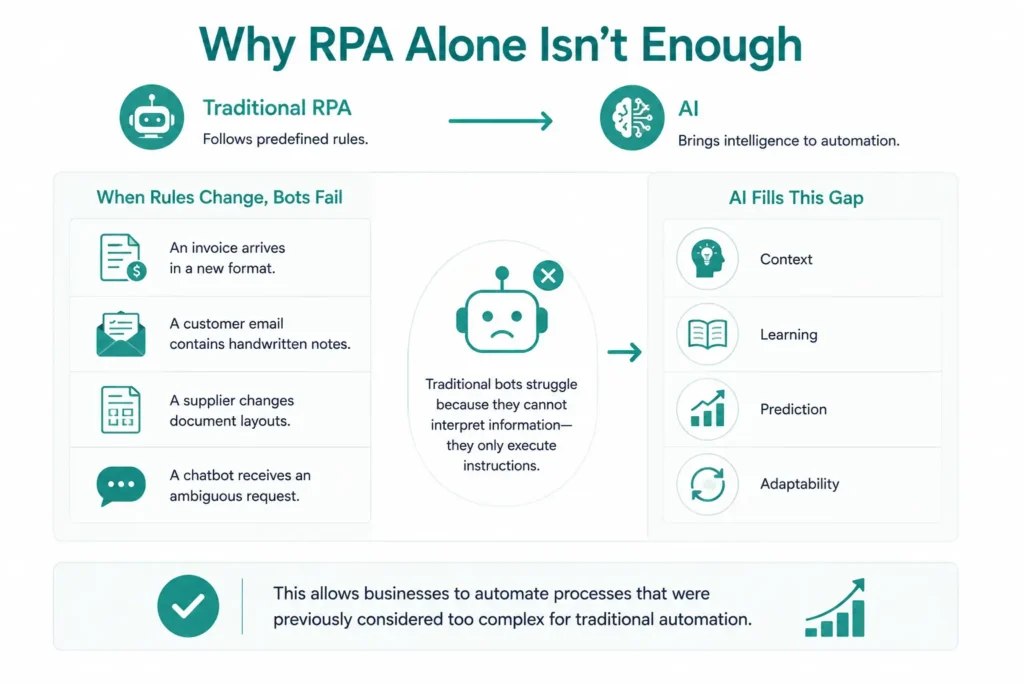
Traditional RPA follows predefined rules.
If those rules change unexpectedly, bots fail.
For example:
An invoice arrives in a new format.
A customer email contains handwritten notes.
A supplier changes document layouts.
A chatbot receives an ambiguous request.
Traditional bots struggle because they cannot interpret information—they only execute instructions.
AI fills this gap by introducing:
✔ Context
✔ Learning
✔ Prediction
✔ Adaptability
This allows businesses to automate processes that were previously considered too complex for traditional automation.
How AI and RPA Work Together
Instead of replacing one another, AI and RPA complement each other throughout the automation lifecycle.
g Business Process
│
▼
AI Engine
(Analyze • Predict • Learn)
│
▼
Decision & Intelligence
│
▼
RPA Bots
(Execute • Update Systems • Trigger Workflows)
│
▼
Business Outcome
This collaboration creates automation that is:
- Faster
- Smarter
- More adaptive
- Easier to scale
- More resilient to change
Key Benefits of Combining AI and RPA
Organizations implementing Intelligent Automation consistently achieve greater business value than those relying on automation alone.
Increased Productivity
AI handles analysis while RPA performs execution.
Employees spend less time on repetitive administrative work and more time solving business problems, serving customers, and driving innovation.
Better Decision-Making
AI transforms large volumes of business data into actionable insights.
RPA immediately executes those decisions without delays.
This creates faster, data-driven operations.
Improved Customer Experience
Intelligent Automation enables:
- Personalized recommendations
- Faster response times
- 24/7 virtual assistance
- Proactive customer support
Meanwhile, RPA completes backend processes seamlessly without customer involvement.
Lower Operational Costs
Organizations reduce:
- Manual effort
- Processing errors
- Rework
- Operational delays
- Compliance costs
This leads to measurable improvements in ROI.
Greater Business Scalability
Unlike traditional growth models, Intelligent Automation allows businesses to increase transaction volumes without proportionally increasing workforce size.
This enables sustainable, profitable growth.
Signs Your Business Is Ready for AI + RPA
Your organization is an ideal candidate for Intelligent Automation if you experience:
- High volumes of repetitive manual work.
- Increasing operational costs.
- Multiple disconnected business systems.
- Growing compliance requirements.
- Large amounts of business data.
- Slow customer response times.
- Frequent human errors.
- Difficulty scaling operations.
Organizations facing these challenges often achieve the fastest ROI through RPA implementation services that combine automation strategy with AI-driven decision-making.
If you’re beginning your automation journey, it’s equally important to choose the right implementation partner. Learn more in How to Choose a Service Provider to Fulfill Your RPA Vision, which outlines the key factors for selecting an experienced automation partner.
Key Takeaways
|
Traditional Automation |
Intelligent Automation |
|
Automates repetitive tasks |
Automates tasks and decision-making |
|
Rule-based execution |
Learns and improves continuously |
|
Limited adaptability |
Handles dynamic business scenarios |
|
Structured data only |
Structured and unstructured data |
|
Human intervention required for exceptions |
AI manages many exceptions automatically |
|
Improves efficiency |
Improves efficiency, intelligence, and business agility |
How AI + RPA Accelerates Business Growth
Organizations that successfully combine Artificial Intelligence with Robotic Process Automation don’t simply automate tasks—they transform how work gets done. Intelligent Automation enables businesses to make faster decisions, reduce operational bottlenecks, improve customer experiences, and scale efficiently without a proportional increase in costs.
Let’s explore the biggest ways AI and RPA create measurable business value.
Unlocking Enterprise-Wide Productivity
One of the biggest barriers to business growth is repetitive manual work.
Employees often spend hours every day performing administrative tasks like:
- Copying data between systems
- Processing invoices
- Updating customer records
- Generating reports
- Validating transactions
- Responding to repetitive customer queries
While these activities are essential, they consume valuable time that could be spent on innovation, strategic planning, or customer engagement.
Intelligent Automation changes this equation.
RPA handles repetitive execution, while AI analyzes information and manages exceptions. This allows employees to focus on higher-value responsibilities that directly contribute to business growth.
Business Benefits
✔ Faster task completion
✔ Reduced manual effort
✔ Higher employee productivity
✔ Fewer processing errors
✔ Improved operational efficiency
Example
A financial institution processing thousands of invoices daily can use RPA to extract, validate, and post invoice data into its ERP system. AI simultaneously identifies duplicate invoices, flags unusual payment patterns, and predicts potential fraud.
Instead of reviewing every invoice manually, finance teams only investigate flagged exceptions—saving hundreds of hours every month.
Smarter Decision-Making Through AI Insights
Modern businesses generate enormous volumes of data every day.
Unfortunately, collecting data alone doesn’t improve business performance.
The real advantage comes from transforming raw information into actionable insights.
Artificial Intelligence continuously analyzes structured and unstructured data to uncover trends, detect anomalies, forecast demand, and recommend actions.
RPA then executes those recommendations automatically.
Together, they create a continuous cycle of intelligent decision-making.
Example Workflow
Customer Data
│
▼
AI Analytics Engine
(Pattern Recognition & Prediction)
│
▼
Business Recommendation
│
▼
RPA Executes Action
│
▼
Business Outcome
Business Applications
AI and RPA work together to enable:
- Demand forecasting
- Sales predictions
- Fraud detection
- Customer segmentation
- Inventory optimization
- Workforce planning
- Dynamic pricing
Instead of waiting days for reports, organizations receive real-time recommendations and automated execution.
Delivering Exceptional Customer Experiences
Customer expectations have changed dramatically.
Today’s customers expect:
- Instant responses
- Personalized recommendations
- Accurate information
- 24/7 availability
- Seamless digital experiences
Meeting these expectations manually is nearly impossible.
Intelligent Automation enables businesses to provide consistent, personalized customer experiences at scale.
How AI + RPA Improve Customer Service
AI handles customer interactions through:
- Virtual assistants
- Chatbots
- Sentiment analysis
- Intent recognition
- Personalized recommendations
Meanwhile, RPA works behind the scenes by:
- Updating CRM systems
- Processing orders
- Verifying customer information
- Creating service tickets
- Sending confirmations
- Triggering workflows
Customers experience faster resolutions without realizing multiple systems are working together automatically.
Result
Higher customer satisfaction.
Reduced response times.
Improved customer retention.
Better Net Promoter Scores (NPS).
Scaling Operations Without Increasing Costs
Traditionally, business growth required hiring more employees.
More customers meant:
- More support staff
- More finance teams
- More operations personnel
- Larger administrative departments
Intelligent Automation breaks this relationship.
Organizations can process significantly higher transaction volumes without proportionally increasing operational costs.
Traditional Growth Model
|
Business Growth |
Operational Cost |
|
More customers |
More employees |
|
More transactions |
Higher overhead |
|
More work |
Larger infrastructure |
Intelligent Automation Model
|
Business Growth |
Operational Cost |
|
More customers |
Minimal increase |
|
More transactions |
Same workforce |
|
Higher demand |
Automated scaling |
This creates sustainable business growth while improving profitability.
Improving Compliance and Risk Management
Highly regulated industries face increasing compliance requirements.
Examples include:
- Banking
- Healthcare
- Insurance
- Manufacturing
- Pharmaceuticals
Manual compliance processes are often slow, inconsistent, and prone to human error.
AI and RPA simplify regulatory compliance by continuously monitoring processes, validating transactions, and generating audit-ready documentation.
Intelligent Automation Can
✔ Monitor transactions in real time
✔ Detect suspicious activities
✔ Enforce compliance policies
✔ Generate audit reports automatically
✔ Maintain complete process logs
✔ Identify regulatory risks early
This significantly reduces compliance costs while improving governance.
Enabling Faster Innovation
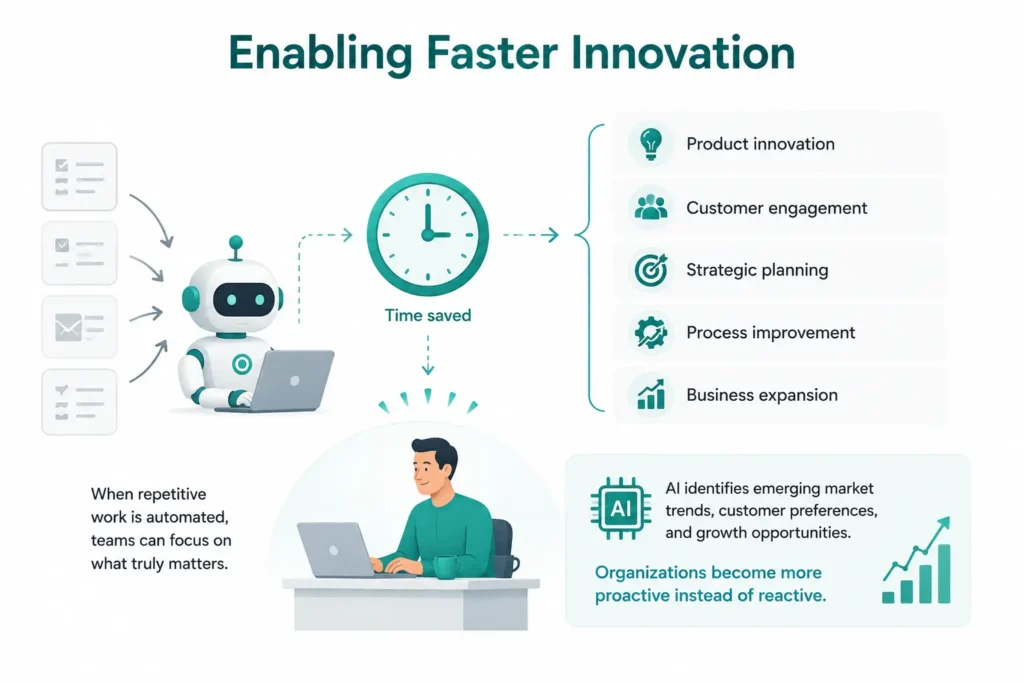
One of the most overlooked benefits of Intelligent Automation is the time it gives back to employees.
When repetitive work is automated, teams can focus on:
- Product innovation
- Customer engagement
- Strategic planning
- Process improvement
- Business expansion
AI further supports innovation by identifying emerging market trends, customer preferences, and growth opportunities.
Organizations become more proactive instead of reactive.
Real-World Industry Applications
The combination of AI and RPA is transforming virtually every industry.
|
Industry |
Intelligent Automation Use Cases |
|
Banking & Financial Services |
Loan processing, fraud detection, KYC verification, reconciliation |
|
Healthcare |
Patient scheduling, medical records, insurance claims, diagnostics support |
|
Predictive maintenance, production planning, quality inspections |
|
|
Retail & E-commerce |
Inventory optimization, personalized recommendations, order processing |
|
Insurance |
Claims automation, underwriting support, policy management |
|
Logistics & Supply Chain |
Shipment tracking, warehouse automation, demand forecasting |
|
Telecommunications |
Customer onboarding, billing automation, service provisioning |
Regardless of industry, Intelligent Automation enables organizations to operate faster, smarter, and more efficiently.
For manufacturers looking to automate operations, Robotic Process Automation in Manufacturing explores practical applications of automation across production, supply chain, and quality management.
A Practical Roadmap for Implementing AI + RPA
Successful Intelligent Automation doesn’t happen overnight. Organizations that achieve long-term success typically follow a structured implementation approach.
Identify Business Processes
│
▼
Process Discovery & Assessment
│
▼
Select High-Value Automation Opportunities
│
▼
Develop RPA Workflows
│
▼
Integrate AI Capabilities
│
▼
Test & Validate
│
▼
Deploy to Production
│
▼
Monitor, Optimize & Scale
Working with experienced RPA implementation services providers ensures each stage is aligned with business goals, governance requirements, and long-term scalability.
Best Practices for Successful Intelligent Automation
Organizations that consistently achieve strong ROI from AI and RPA follow these proven practices:
- Start with high-volume, rule-based processes before introducing AI.
- Establish an automation roadmap aligned with business objectives.
- Standardize governance through an Automation Center of Excellence (CoE).
- Integrate AI gradually into existing RPA workflows.
- Continuously monitor automation performance using business KPIs.
- Prioritize security, compliance, and data privacy from the beginning.
- Invest in employee training to encourage adoption and collaboration.
For organizations planning enterprise-wide automation, following established Robotic Process Automation best practices can significantly improve implementation success and long-term scalability.
Common Challenges When Combining AI and RPA
Although Intelligent Automation offers tremendous business value, implementing AI and RPA together requires careful planning. Organizations often face technical, operational, and organizational challenges that can slow adoption if not addressed early.
Understanding these challenges helps businesses build a stronger automation strategy and maximize long-term ROI.
Choosing the Wrong Processes
One of the biggest mistakes organizations make is trying to automate every process immediately.
Not every workflow requires AI.
Similarly, not every process is suitable for traditional RPA.
For example:
- Rule-based invoice processing → Ideal for RPA
- Customer sentiment analysis → Requires AI
- Fraud detection → AI + RPA
- Strategic negotiations → Human expertise
Best Practice
Begin with:
✔ High-volume tasks
✔ Rule-based workflows
✔ Stable business processes
Once these are optimized, gradually introduce AI into processes involving decision-making, document understanding, or predictive analytics.
Data Quality Issues
Artificial Intelligence depends on data.
Poor-quality data produces poor-quality decisions.
Incomplete records, duplicate information, inconsistent formats, and outdated databases significantly reduce AI accuracy.
How to Overcome It
Organizations should:
- Clean historical data.
- Standardize business data.
- Establish data governance policies.
- Continuously monitor data quality.
- Eliminate duplicate records.
Clean data dramatically improves automation outcomes.
Employee Resistance to Intelligent Automation
Many employees still believe automation will replace jobs.
In reality, AI and RPA are designed to augment human capabilities rather than replace skilled professionals.
When repetitive work is automated, employees can focus on:
- Customer relationships
- Innovation
- Business strategy
- Complex problem-solving
- Creative decision-making
Building Employee Confidence
Successful organizations:
✔ Communicate automation goals clearly.
✔ Involve employees throughout implementation.
✔ Offer automation training.
✔ Reskill employees for higher-value roles.
When employees understand automation benefits, adoption increases significantly.
Security and Compliance
AI and RPA testing process highly sensitive information such as:
- Financial transactions
- Customer records
- Healthcare information
- Employee data
- Business contracts
Without proper governance, automation can introduce compliance risks.
Recommended Security Practices
- Multi-factor authentication
- Role-Based Access Control (RBAC)
- Secure credential vaults
- Data encryption
- Continuous monitoring
- Audit logging
- Regulatory compliance validation
An experienced RPA service provider ensures security is embedded throughout the automation lifecycle—not added later.
Scaling Beyond Pilot Projects
Many organizations achieve quick success with one or two bots but struggle to expand automation across departments.
Common reasons include:
- Lack of governance
- Poor architecture
- Inconsistent development standards
- Limited infrastructure
- No Center of Excellence (CoE)
Enterprise-wide automation requires standardized frameworks that support long-term scalability.
Organizations looking to overcome these barriers can explore 10 RPA Challenges and How to Overcome Them, which provides additional implementation guidance.
Measuring the ROI of AI + RPA
Business leaders often ask:
“How do we measure the success of Intelligent Automation?”
The answer goes beyond simple cost savings.
Organizations should evaluate automation using operational, financial, and customer-centric metrics.
Key Performance Indicators
|
KPI |
Business Value |
|
Process Cycle Time |
Faster service delivery |
|
Operational Cost Reduction |
Lower operating expenses |
|
Employee Productivity |
Higher-value work completed |
|
Error Rate |
Improved quality and compliance |
|
Customer Satisfaction (CSAT) |
Better customer experiences |
|
Return on Investment (ROI) |
Financial impact |
|
Automation Coverage |
Percentage of automated processes |
|
Compliance Accuracy |
Reduced regulatory risk |
Tracking these metrics helps organizations continuously optimize automation performance while demonstrating measurable business outcomes.
The Future of AI + RPA
Intelligent Automation is evolving rapidly.
Over the next few years, businesses will move beyond task automation toward autonomous enterprise operations powered by AI.
Several emerging trends are shaping the future.
Generative AI Integration
Large Language Models (LLMs) will enable bots to:
- Generate reports
- Draft emails
- Summarize documents
- Create customer responses
- Assist employees in real time
Hyperautomation
Organizations will increasingly combine:
- RPA
- Artificial Intelligence
- Process Mining
- Business Process Management (BPM)
- Low-Code Platforms
- Intelligent Document Processing (IDP)
This creates end-to-end automation ecosystems rather than isolated workflows.
Predictive Business Operations
Instead of reacting to problems, AI will anticipate them.
Examples include:
- Predicting equipment failures.
- Forecasting customer churn.
- Detecting fraud before transactions occur.
- Optimizing inventory automatically.
Autonomous Decision-Making
Future AI systems will continuously learn from business data, allowing organizations to automate increasingly complex decision-making processes while maintaining governance and compliance.
The businesses investing today will be best positioned to lead tomorrow.
Why Choose MicroGenesis for Intelligent Automation?
Successful Intelligent Automation requires much more than implementing software tools.
It requires a strategic partner with deep expertise in automation, AI, enterprise applications, governance, and digital transformation.
As a trusted RPA services company, MicroGenesis helps organizations design, implement, and scale Intelligent Automation solutions that deliver measurable business value.
Our Capabilities
Strategic RPA Consulting Services
We assess your business processes, identify automation opportunities, and develop a roadmap aligned with your digital transformation goals.
End-to-End RPA Implementation Services
Our comprehensive services include:
- Process discovery
- Automation strategy
- Bot development
- AI integration
- Testing & validation
- Deployment
- Managed support
- Continuous optimization
Multi-Platform Expertise
We work with leading automation technologies, including:
- UiPath
- Microsoft Power Automate
- Automation Anywhere
- Blue Prism
This platform-independent approach allows us to recommend the right technology stack for your unique business requirements.
Intelligent Automation Solutions
Beyond traditional automation, we integrate:
- Artificial Intelligence
- Machine Learning
- OCR
- NLP
- Predictive Analytics
to build intelligent workflows capable of adapting to changing business conditions.
Intelligent Automation Readiness Checklist
Before beginning your AI + RPA journey, ask yourself:
|
Question |
Ready? |
|
Have we identified the right business processes? |
☐ |
|
Are our business objectives clearly defined? |
☐ |
|
Is our data accurate and well-governed? |
☐ |
|
Do we have executive sponsorship? |
☐ |
|
Have we established automation governance? |
☐ |
|
Are employees prepared for change? |
☐ |
|
Do we have KPIs to measure success? |
☐ |
|
Is our infrastructure scalable? |
☐ |
|
Do we have the right implementation partner? |
☐ |
Organizations that can confidently answer “Yes” to these questions are significantly more likely to achieve long-term automation success.
Conclusion
The future of business growth is no longer driven by automation alone—it’s powered by Intelligent Automation, where Artificial Intelligence and Robotic Process Automation work together to transform operations, improve decision-making, and create exceptional customer experiences.
While RPA streamlines repetitive, rule-based tasks, AI adds the intelligence needed to interpret data, predict outcomes, and adapt to changing business conditions. Together, they enable organizations to build agile, scalable, and future-ready operations capable of responding to today’s dynamic business challenges.
However, unlocking the full value of Intelligent Automation requires more than implementing technology. It demands a clear strategy, robust governance, high-quality data, employee adoption, and continuous optimization. Partnering with an experienced RPA consulting services provider ensures that every stage of the journey—from process discovery and implementation to AI integration and ongoing support—is aligned with your business objectives.
At MicroGenesis, we help organizations harness the combined power of AI and RPA through comprehensive RPA implementation services tailored to industry-specific requirements. As a trusted RPA service provider and digital transformation partner, we empower businesses to automate intelligently, innovate confidently, and scale sustainably.
Whether you’re beginning with your first automation initiative or building an enterprise-wide Intelligent Automation strategy, MicroGenesis provides the expertise, technology, and support needed to turn automation into a lasting competitive advantage.


