


As organizations accelerate digital transformation, software delivery has become a critical competitive advantage. Customers expect new features, seamless user experiences, and highly available applications delivered at an unprecedented pace. Meeting these expectations requires more than traditional IT infrastructure and manual deployment processes.
This is where cloud computing and DevOps have become a powerful combination.
Individually, cloud computing provides scalable infrastructure and on-demand resources, while DevOps improves collaboration, automation, and continuous software delivery. Together, they enable organizations to build, test, deploy, and manage applications faster, more securely, and with greater operational efficiency.
Modern enterprises no longer view cloud migration as simply moving workloads to another platform. Instead, they are embracing cloud-native architectures powered by DevOps practices such as Infrastructure as Code (IaC), Continuous Integration and Continuous Delivery (CI/CD), containerization, automated monitoring, and DevSecOps.
Organizations adopting cloud-powered DevOps can reduce deployment times from weeks to hours, improve application reliability, automate infrastructure management, and respond rapidly to changing business demands.
Businesses planning cloud modernization should first understand the common challenges in cloud and DevOps integration and how addressing them early leads to more successful cloud adoption.
In this guide, we’ll explore how cloud computing strengthens DevOps practices, why this combination has become essential for modern software development, and how organizations can build scalable, secure, and future-ready delivery pipelines.
Understanding DevOps
DevOps is more than a collection of tools—it’s a culture that brings together development, operations, quality assurance, and security teams to improve collaboration and automate the software delivery lifecycle.
Instead of working in isolated silos, DevOps encourages continuous collaboration from planning and development through testing, deployment, monitoring, and ongoing optimization.
The primary goals of DevOps include:
- Faster software delivery
- Improved collaboration
- Continuous Integration and Continuous Delivery (CI/CD)
- Infrastructure automation
- Continuous monitoring
- Rapid feedback loops
- Higher software quality
- Increased operational reliability
By automating repetitive tasks and standardizing workflows, DevOps enables teams to deliver software faster while maintaining consistency and reducing deployment risks.
Organizations building mature DevOps practices often strengthen their software delivery by implementing structured DevOps pipelines that automate every stage of application development and deployment.
Understanding Cloud Computing
Cloud computing provides organizations with on-demand access to computing resources—including servers, networking, databases, storage, analytics, and development platforms—without requiring significant upfront infrastructure investments.
Instead of purchasing and maintaining physical hardware, businesses consume cloud services as needed while paying only for the resources they use.
The three primary cloud service models include:
| Cloud Model | Description | Examples |
| Infrastructure as a Service (IaaS) | Virtualized infrastructure such as servers, networking, and storage. | AWS EC2, Azure Virtual Machines |
| Platform as a Service (PaaS) | Managed platforms for building and deploying applications. | Google App Engine, Azure App Service |
| Software as a Service (SaaS) | Ready-to-use software delivered through the cloud. | Jira Cloud, Microsoft 365, Salesforce |
Organizations also choose between different deployment models depending on business and regulatory requirements:
- Public Cloud
- Private Cloud
- Hybrid Cloud
- Multi-Cloud
Each model offers different levels of flexibility, scalability, governance, and control.
Why Cloud Computing and DevOps Work Better Together
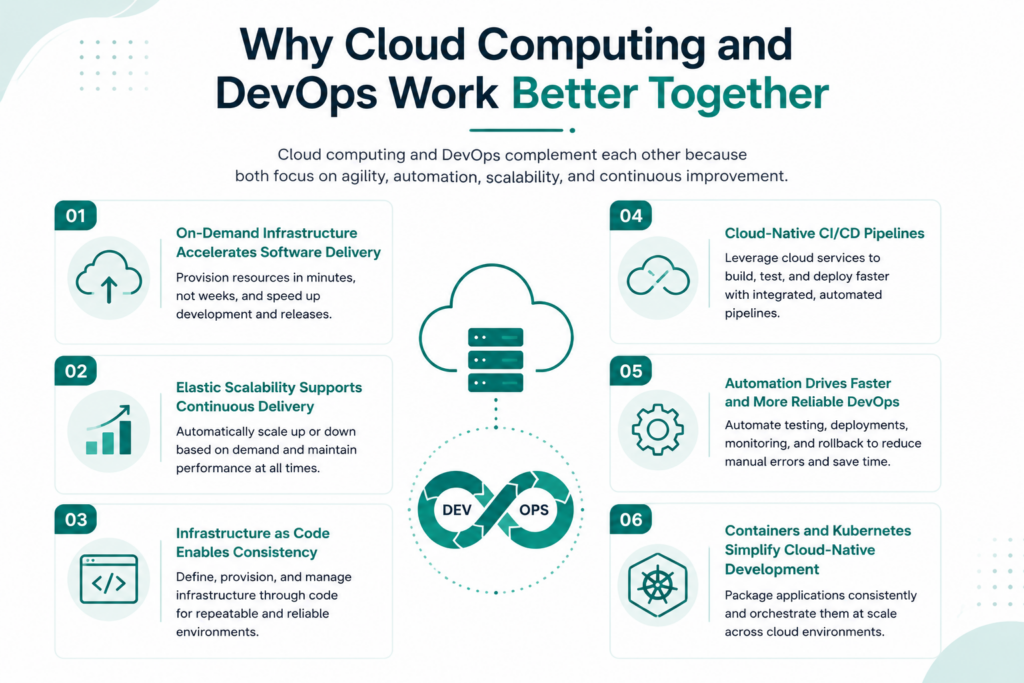
Cloud computing and DevOps complement each other because both focus on agility, automation, scalability, and continuous improvement.
Cloud platforms provide the infrastructure needed for DevOps automation, while DevOps enables organizations to fully utilize cloud capabilities through standardized development and deployment processes.
Together they enable:
- Rapid infrastructure provisioning
- Continuous software delivery
- Automated testing
- Cloud-native application development
- Infrastructure scalability
- Continuous monitoring
- Faster disaster recovery
- Lower operational costs
Rather than treating infrastructure as a bottleneck, development teams can provision cloud environments on demand and focus on delivering business value.
Organizations modernizing cloud environments often combine DevOps with cloud migration strategies to accelerate application modernization and reduce migration risks.
Keyways Cloud Computing Enhances DevOps Practices
1. On-Demand Infrastructure Accelerates Software Delivery
Traditional infrastructure provisioning often requires manual approvals, hardware procurement, and lengthy configuration processes.
Cloud computing eliminates these delays by allowing development teams to provision complete environments within minutes.
Using Infrastructure as Code (IaC), cloud resources can be automatically created whenever development, testing, or deployment pipelines require them.
This enables:
- Faster application development
- Shorter release cycles
- Reduced infrastructure bottlenecks
- Better environment consistency
Development teams can rapidly create temporary testing environments and remove them once testing is complete, significantly reducing infrastructure costs.
2. Elastic Scalability Supports Continuous Delivery
One of cloud computing’s greatest advantages is elasticity.
Applications can automatically scale based on demand without requiring manual intervention.
For example:
- Additional compute resources during high traffic
- Automatic scaling for Kubernetes clusters
- Temporary infrastructure for CI/CD pipelines
- Automatic resource reduction during low usage
Elastic infrastructure allows DevOps teams to maintain application performance while optimizing cloud costs.
3. Infrastructure as Code Enables Consistency
Infrastructure as Code has become one of the most valuable DevOps practices.
Instead of configuring infrastructure manually, engineers define cloud resources using code stored in version control systems.
Benefits include:
- Repeatable deployments
- Version-controlled infrastructure
- Faster disaster recovery
- Reduced configuration drift
- Simplified auditing
Organizations adopting cloud-native development often strengthen infrastructure automation through containerization in cloud and DevOps environments, creating highly portable and scalable application platforms.
4. Cloud-Native CI/CD Pipelines
Cloud platforms simplify Continuous Integration and Continuous Delivery by providing managed DevOps services and seamless integration with development tools.
Modern cloud-native CI/CD pipelines automate:
- Code validation
- Application builds
- Testing
- Security scanning
- Container image creation
- Production deployment
This enables organizations to release software more frequently while reducing deployment risks.
5. Automation Drives Faster and More Reliable DevOps
Automation is at the heart of both cloud computing and DevOps. As applications become more complex, manually managing infrastructure, deployments, testing, and monitoring becomes inefficient and prone to errors. Cloud platforms provide the flexibility and APIs needed to automate nearly every stage of the software development lifecycle.
Organizations can automate:
- Infrastructure provisioning
- Application deployments
- Configuration management
- Software testing
- Security validation
- Backup and disaster recovery
- Performance monitoring
- Scaling policies
By eliminating repetitive manual tasks, teams can focus more on innovation and delivering customer value.
Businesses looking to mature their automation capabilities should also explore DevOps automation best practices and strategies to build scalable and efficient software delivery pipelines.
6. Containers and Kubernetes Simplify Cloud-Native Development
Modern DevOps teams increasingly rely on containers to package applications together with their dependencies, ensuring consistent deployments across development, testing, and production environments.
Unlike traditional virtual machines, containers are lightweight, portable, and start within seconds, making them ideal for continuous deployment.
Benefits of containerized applications include:
- Faster application startup
- Consistent runtime environments
- Simplified deployments
- Better resource utilization
- Improved scalability
As container adoption grows, organizations use Kubernetes to orchestrate and manage large numbers of containers across cloud environments.
Kubernetes automates:
- Container deployment
- Service discovery
- Load balancing
- Auto-scaling
- Self-healing
- Rolling updates
- Automatic rollback
This combination of containers and orchestration enables organizations to deploy resilient, cloud-native applications at enterprise scale.
Teams adopting Kubernetes should also understand GitLab Enterprise DevOps architecture for managing containerized software delivery across large engineering organizations.
7. Infrastructure as Code Improves Cloud Consistency
Managing cloud infrastructure manually often leads to configuration drift, deployment inconsistencies, and operational inefficiencies.
Infrastructure as Code (IaC) addresses these challenges by allowing infrastructure to be defined, version-controlled, reviewed, and deployed using code.
Using IaC enables organizations to:
- Standardize infrastructure
- Reduce manual errors
- Accelerate provisioning
- Simplify disaster recovery
- Improve compliance
- Support multi-cloud deployments
Every infrastructure change becomes traceable, repeatable, and easier to audit.
8. Cloud-Native Monitoring and Observability
Successful DevOps teams rely on continuous visibility into application performance and infrastructure health.
Cloud platforms provide built-in monitoring capabilities that help organizations identify issues before they affect end users.
Modern observability includes:
Infrastructure Monitoring
Track CPU, memory, storage, networking, and cloud resources.
Application Performance Monitoring (APM)
Measure application response times, availability, latency, and user experience.
Centralized Logging
Aggregate logs from applications, containers, databases, and cloud services into a single platform for faster troubleshooting.
Distributed Tracing
Monitor requests as they travel across multiple microservices to quickly identify performance bottlenecks.
Continuous observability enables faster incident response and supports data-driven optimization across the software delivery lifecycle.
Organizations managing hybrid cloud environments should also explore optimizing IT operations in hybrid and multi-cloud environments to improve visibility and operational efficiency.
9. DevSecOps Strengthens Cloud Security
Security is no longer a separate phase that occurs after development. Modern organizations integrate security directly into DevOps workflows through DevSecOps, ensuring that security checks are performed continuously throughout the software development lifecycle.
Cloud platforms simplify this process by providing built-in capabilities such as:
- Identity and Access Management (IAM)
- Encryption at rest and in transit
- Secrets management
- Policy enforcement
- Compliance monitoring
- Automated vulnerability scanning
By integrating security into CI/CD pipelines, organizations can identify and remediate vulnerabilities before applications reach production.
Businesses adopting cloud-native security should understand DevSecOps and how automated security improves software quality while reducing compliance risks.
10. Cloud Improves Collaboration Across Distributed Teams
Modern software development often involves teams working across different locations, time zones, and business units.
Cloud-based development platforms enable seamless collaboration by providing centralized access to code repositories, project management tools, documentation, and deployment pipelines.
Development teams benefit from:
- Shared source code repositories
- Real-time collaboration
- Centralized documentation
- Automated notifications
- Integrated issue tracking
- Faster knowledge sharing
Cloud-hosted collaboration platforms reduce communication gaps while improving productivity throughout the software delivery lifecycle.
Organizations looking to strengthen collaboration should also adopt DevOps culture best practices to encourage shared ownership, transparency, and continuous improvement.
Cloud-Powered DevOps at a Glance
| DevOps Capability | Traditional Infrastructure | Cloud-Powered DevOps |
| Infrastructure Provisioning | Manual and time-consuming | Automated with Infrastructure as Code |
| Software Deployment | Scheduled releases | Continuous delivery with CI/CD |
| Scalability | Limited by physical hardware | Automatic scaling based on demand |
| Monitoring | Reactive monitoring | Real-time observability and automated alerts |
| Security | Manual security reviews | Integrated DevSecOps and continuous compliance |
| Collaboration | Siloed teams | Shared cloud-native development platforms |
By combining cloud computing with DevOps principles, organizations create highly automated, scalable, and resilient software delivery ecosystems capable of supporting continuous innovation.
Common Challenges When Combining Cloud and DevOps
While cloud computing enhances DevOps significantly, organizations must address several technical and organizational challenges to fully realize its benefits.
Managing Multi-Cloud Complexity
Many enterprises use multiple cloud providers to improve resilience, avoid vendor lock-in, or meet compliance requirements. However, managing applications across different cloud platforms introduces operational complexity.
Challenges include:
- Different cloud services and APIs
- Inconsistent security policies
- Complex networking
- Multiple monitoring platforms
- Governance across providers
Organizations should establish standardized automation practices and centralized governance to simplify multi-cloud operations.
Cost Management
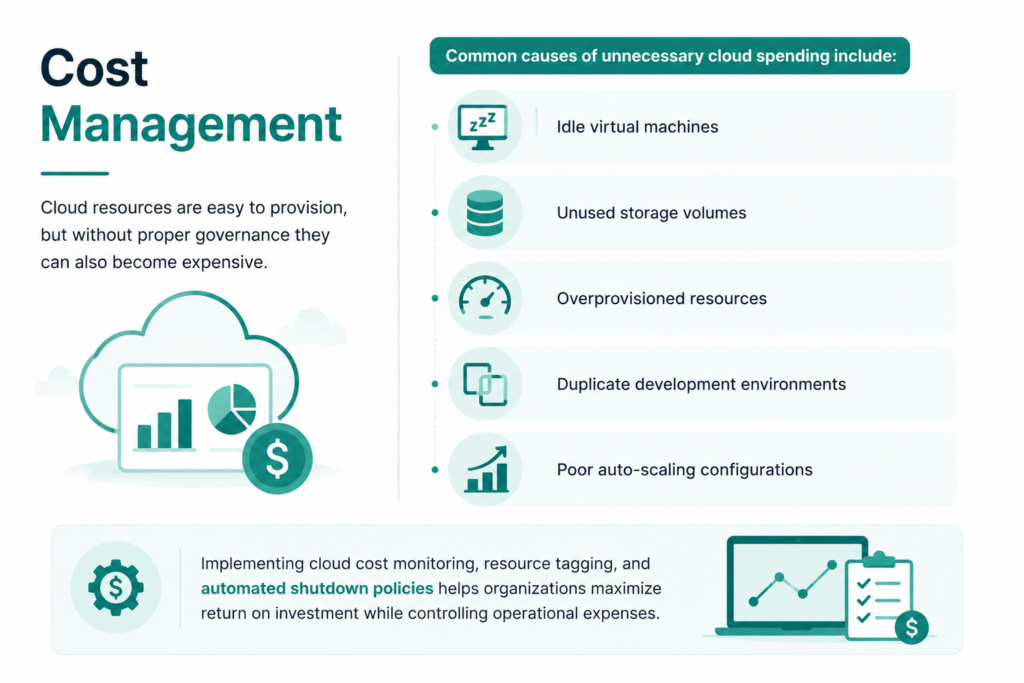
Cloud resources are easy to provision, but without proper governance they can also become expensive.
Common causes of unnecessary cloud spending include:
- Idle virtual machines
- Unused storage volumes
- Overprovisioned resources
- Duplicate development environments
- Poor auto-scaling configurations
Implementing cloud cost monitoring, resource tagging, and automated shutdown policies helps organizations maximize return on investment while controlling operational expenses.
Security and Compliance
Cloud-native applications introduce new security considerations that must be addressed throughout the software development lifecycle.
Organizations should integrate:
- Identity and Access Management (IAM)
- Multi-factor authentication
- Automated vulnerability scanning
- Secrets management
- Compliance monitoring
- Policy-as-Code
Embedding security directly into development pipelines creates a proactive security model rather than relying on manual reviews before deployment.
Skills and Cultural Transformation
Cloud adoption is as much about people as it is about technology.
Development, operations, and security teams must embrace:
- Shared ownership
- Automation-first thinking
- Continuous learning
- Cross-functional collaboration
- Agile delivery practices
Building a strong DevOps culture remains one of the most important success factors for cloud transformation initiatives.
Best Practices for Cloud-Powered DevOps
Organizations that successfully combine cloud computing and DevOps consistently follow several proven best practices.
Automate Infrastructure
Provision cloud infrastructure using Infrastructure as Code to ensure consistency, repeatability, and faster deployments.
Build Cloud-Native CI/CD Pipelines
Automate building, testing, security validation, and deployments to reduce manual effort and accelerate software delivery.
Adopt Containerization
Package applications into containers for portability, scalability, and consistent deployments across cloud environments.
Organizations modernizing application delivery can also explore containerization in cloud and DevOps environments to understand how containers simplify cloud-native software development.
Monitor Everything
Implement centralized monitoring for infrastructure, applications, logs, user experience, and security events.
Continuous observability enables proactive incident management and ongoing optimization.
Integrate Security from the Beginning
Adopt DevSecOps practices that automate security testing, compliance validation, and vulnerability scanning throughout the software delivery lifecycle.
Continuously Optimize
Cloud environments evolve continuously.
Organizations should regularly review:
- Infrastructure utilization
- Application performance
- Deployment frequency
- Recovery time
- Cloud spending
- Security posture
Continuous optimization ensures long-term operational efficiency while maximizing business value.
Future Trends Shaping Cloud and DevOps
Cloud computing and DevOps continue to evolve rapidly as organizations embrace automation, artificial intelligence, and cloud-native technologies.
Some of the most important trends include:
AI-Powered Operations (AIOps)
Artificial intelligence is increasingly being used to predict incidents, optimize cloud resources, automate root cause analysis, and improve operational decision-making.
Organizations preparing for intelligent cloud operations should also explore Artificial Intelligence for IT Operations (AIOps) to understand how AI enhances infrastructure management and service reliability
GitOps
GitOps extends DevOps by using Git repositories as the single source of truth for infrastructure and application deployments.
Benefits include:
- Improved consistency
- Better auditability
- Automated deployments
- Simplified rollback
- Enhanced collaboration
Serverless Computing
Serverless platforms allow developers to focus entirely on application logic while cloud providers manage infrastructure, scaling, and availability.
Organizations building modern cloud-native applications should understand serverless architectures and DevOps to simplify deployment while reducing operational overhead.
Platform Engineering
Platform engineering is emerging as a key discipline that enables development teams to consume standardized cloud infrastructure and DevOps capabilities through internal developer platforms.
This approach improves developer productivity while maintaining governance and operational consistency.
Why Choose MicroGenesis for Cloud and DevOps Transformation?
Successfully integrating cloud computing with DevOps requires more than adopting the latest technologies. It demands a strategic approach that aligns infrastructure, automation, security, and software delivery with business objectives.
MicroGenesis delivers DevOps consulting services to help organizations accelerate cloud transformation by designing and implementing scalable DevOps solutions tailored to their unique operational requirements. From cloud migration and Infrastructure as Code to CI/CD automation, containerization, Kubernetes, and DevSecOps, our DevOps implementation services enable businesses to modernize software delivery while improving security, reliability, and operational efficiency.
Our expertise includes:
- Cloud migration strategy and execution
- DevOps consulting and implementation
- CI/CD pipeline design
- Infrastructure as Code (IaC)
- Kubernetes and container orchestration
- DevSecOps integration
- Cloud optimization and managed services
By combining technical expertise with proven industry best practices, MicroGenesis helps organizations reduce deployment complexity, accelerate innovation, and maximize the value of their cloud investments.
Conclusion
Cloud computing and DevOps have fundamentally transformed how modern organizations develop, deploy, and manage software. While cloud platforms provide scalable, flexible infrastructure, DevOps introduces the automation, collaboration, and continuous delivery practices needed to fully leverage those capabilities.
Together, they enable faster software releases, improved operational resilience, stronger security, and greater business agility. Organizations that invest in cloud-native DevOps practices are better positioned to adapt to changing market demands, optimize infrastructure costs, and deliver exceptional digital experiences.
As technologies such as AI-driven operations, GitOps, serverless computing, and platform engineering continue to evolve, the synergy between cloud computing and DevOps will become even more critical for organizations pursuing long-term digital transformation.
With MicroGenesis as your trusted technology partner, you can confidently modernize your cloud infrastructure, streamline software delivery, and build a secure, scalable, and future-ready DevOps ecosystem that drives continuous innovation and sustainable business growth.


