


Modern software development is no longer defined solely by the tools organizations use—it is defined by how effectively people, processes, and technology work together. As businesses accelerate digital transformation, customer expectations continue to rise. Organizations are expected to release software faster, maintain exceptional quality, strengthen security, and adapt quickly to changing market demands.
While technologies such as cloud computing, containers, Kubernetes, Infrastructure as Code (IaC), and AI-powered automation have transformed software delivery, technology alone cannot guarantee success. Organizations that consistently achieve faster release cycles, higher deployment reliability, and better customer experiences share one common characteristic: a strong DevOps culture.
DevOps is more than a development methodology or automation framework. It is a cultural transformation that encourages collaboration, shared ownership, continuous learning, and ongoing improvement across development, operations, quality assurance, and security teams.
Organizations beginning their transformation should first understand DevOps implementation strategy to align people, processes, and technology with long-term business objectives.
In this guide, we’ll explore five proven best practices that help organizations build a successful DevOps culture and create an environment where innovation, collaboration, and continuous delivery become part of everyday operations.
Why DevOps Culture Matters More Than Ever
Many organizations invest heavily in automation platforms, CI/CD tools, cloud infrastructure, and monitoring solutions but fail to achieve the expected business outcomes.
The reason is simple.
Technology enables DevOps—but culture sustains it.
Without collaboration and shared accountability, even the most advanced DevOps tools create disconnected workflows instead of improving software delivery.
A healthy DevOps culture helps organizations:
- Deliver software faster
- Improve product quality
- Reduce operational risks
- Accelerate innovation
- Increase deployment frequency
- Improve customer satisfaction
- Enhance employee engagement
- Build resilient engineering teams
Rather than treating development, operations, QA, and security as separate departments, DevOps encourages everyone to work toward common business outcomes.
Organizations that successfully embrace DevOps often experience shorter release cycles, improved system reliability, and greater business agility.
Characteristics of High-Performing DevOps Organizations
Successful DevOps teams share several common characteristics that distinguish them from traditional software delivery organizations.
They prioritize:
- Collaboration over silos
- Automation over repetitive manual work
- Shared ownership instead of isolated responsibilities
- Continuous learning instead of blame
- Data-driven decision-making
- Continuous customer feedback
These organizations recognize that DevOps is an ongoing journey of improvement rather than a one-time implementation project.
Best Practice 1: Foster Collaboration and Break Down Organizational Silos
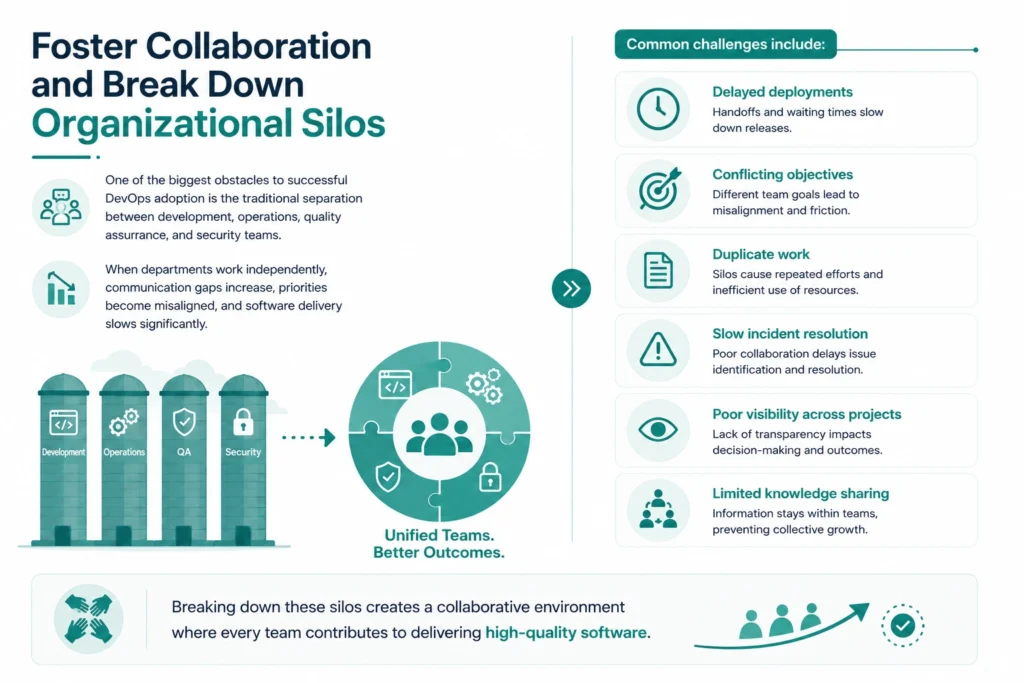
One of the biggest obstacles to successful DevOps adoption is the traditional separation between development, operations, quality assurance, and security teams.
When departments work independently, communication gaps increase, priorities become misaligned, and software delivery slows significantly.
Common challenges include:
- Delayed deployments
- Conflicting objectives
- Duplicate work
- Slow incident resolution
- Poor visibility across projects
- Limited knowledge sharing
Breaking down these silos creates a collaborative environment where every team contributes to delivering high-quality software.
How to Improve Cross-Functional Collaboration
Organizations should encourage teams to work together throughout the entire software development lifecycle rather than collaborating only during releases.
Some effective approaches include:
Build Cross-Functional Teams
Create agile teams that include:
- Developers
- Operations engineers
- QA specialists
- Security professionals
- Product owners
Shared ownership improves accountability while reducing handoffs between departments.
Encourage Transparent Communication
Open communication helps teams identify issues early and resolve them quickly.
Organizations should encourage:
- Daily stand-up meetings
- Sprint planning sessions
- Retrospectives
- Shared dashboards
- Collaboration platforms
- Open documentation
Transparency reduces misunderstandings while improving decision-making.
Align Teams Around Shared Goals
Rather than measuring departments independently, organizations should define common objectives that reflect overall business performance.
Examples include:
- Deployment frequency
- Mean Time to Recovery (MTTR)
- Customer satisfaction
- Application availability
- Release quality
Shared metrics encourage collaboration instead of competition.
Organizations planning enterprise-wide DevOps adoption should also understand DevOps benefits and implementation strategies to establish realistic transformation goals and measurable success metrics.
Promote Knowledge Sharing
Knowledge should never remain isolated within individual teams.
Encourage:
- Pair programming
- Internal workshops
- Technical communities
- Documentation
- Lunch-and-learn sessions
- Cross-team mentoring
Knowledge sharing improves resilience while reducing dependency on individual experts.
Business Impact
Organizations that successfully eliminate organizational silos experience:
- Faster software delivery
- Better collaboration
- Higher software quality
- Improved operational stability
- Greater employee satisfaction
- Stronger customer experiences
Collaboration ultimately becomes a competitive advantage.
Best Practice 2: Build a Culture of Continuous Learning and Improvement
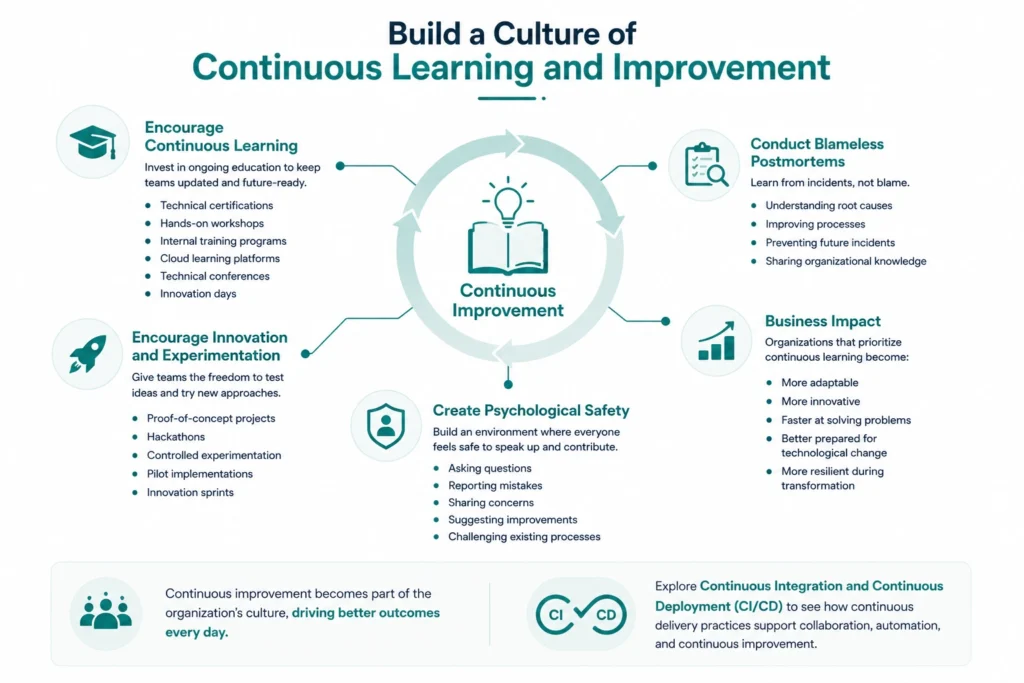
DevOps is built on the principle that software delivery can always be improved.
High-performing organizations continuously evaluate their processes, learn from failures, adopt new technologies, and encourage experimentation.
Instead of viewing incidents as failures, successful DevOps teams treat them as valuable learning opportunities.
Encourage Continuous Learning
Technology evolves rapidly.
Organizations should invest in continuous education to help employees stay current with modern DevOps practices.
Effective initiatives include:
- Technical certifications
- Hands-on workshops
- Internal training programs
- Cloud learning platforms
- Technical conferences
- Innovation days
Continuous learning enables teams to adopt new technologies confidently while improving long-term productivity.
Conduct Blameless Postmortems
Production incidents are inevitable.
What distinguishes successful DevOps organizations is how they respond.
Blameless postmortems focus on:
- Understanding root causes
- Improving processes
- Preventing future incidents
- Sharing organizational knowledge
Rather than assigning blame, teams work together to strengthen the overall software delivery process.
Encourage Innovation and Experimentation
Continuous improvement requires teams to feel comfortable testing new ideas.
Organizations should encourage:
- Proof-of-concept projects
- Hackathons
- Controlled experimentation
- Pilot implementations
- Innovation sprints
Small experiments often lead to major operational improvements.
Create Psychological Safety
Employees should feel comfortable:
- Asking questions
- Reporting mistakes
- Sharing concerns
- Suggesting improvements
- Challenging existing processes
Psychological safety encourages creativity, innovation, and stronger collaboration across teams.
Business Impact
Organizations that prioritize continuous learning become:
- More adaptable
- More innovative
- Faster at solving problems
- Better prepared for technological change
- More resilient during organizational transformation
Continuous improvement ultimately becomes part of the organization’s culture rather than an isolated initiative.
Businesses strengthening their DevOps capabilities should also explore Continuous Integration and Continuous Deployment (CI/CD) to understand how continuous delivery practices support collaboration, automation, and continuous improvement.
Best Practice 3: Make Automation a Core Part of Your Culture
Automation is often considered the backbone of DevOps, but successful organizations understand that automation is more than implementing tools—it’s a mindset. Instead of automating isolated tasks, high-performing DevOps teams continuously identify repetitive processes that can be standardized, optimized, and automated.
When automation becomes part of an organization’s culture, teams spend less time on manual operations and more time delivering customer value.
Automation should extend across the entire Software Development Life Cycle (SDLC), including code integration, testing, infrastructure provisioning, deployments, security, and monitoring.
Areas Every Organization Should Automate
| DevOps Process | Business Benefit |
| Continuous Integration | Faster code validation and fewer integration issues |
| Automated Testing | Early bug detection and improved software quality |
| Continuous Deployment | Faster and more reliable software releases |
| Infrastructure Provisioning | Consistent environments across development, testing, and production |
| Security Scanning | Earlier vulnerability detection |
| Monitoring & Alerts | Faster incident response and proactive issue resolution |
Organizations that automate consistently reduce deployment risks while increasing delivery speed.
Build Reliable CI/CD Pipelines
Continuous Integration and Continuous Deployment (CI/CD) pipelines automate software delivery from code commit to production.
Instead of manually performing builds, testing, approvals, and deployments, automated pipelines ensure every code change follows a standardized and repeatable process.
A mature CI/CD pipeline typically includes:
Code Commit
↓
Automated Build
↓
Code Quality Checks
↓
Automated Testing
↓
Security Validation
↓
Deployment to Staging
↓
Production Release
↓
Continuous Monitoring
This approach reduces human error while enabling teams to deploy software more frequently with greater confidence.
Organizations looking to modernize software delivery should also evaluate CI/CD tools for DevOps teams to select platforms that support scalable enterprise automation
Adopt Infrastructure as Code (IaC)
Managing infrastructure manually often leads to configuration inconsistencies, deployment delays, and operational risks.
Infrastructure as Code (IaC) solves these challenges by allowing infrastructure to be defined, version-controlled, and deployed using code.
Popular IaC tools include:
- Terraform
- AWS CloudFormation
- Azure Resource Manager
- Ansible
- Pulumi
Benefits include:
✔ Faster environment provisioning
✔ Improved consistency
✔ Easier disaster recovery
✔ Better compliance
✔ Reduced manual errors
Treating infrastructure like application code improves reliability while supporting cloud-native scalability.
Standardize Development Processes
Automation works best when teams follow standardized processes.
Organizations should establish common practices for:
- Branching strategies
- Code reviews
- Deployment workflows
- Environment management
- Security validation
- Release approvals
Standardization reduces complexity while making automation easier to maintain across multiple teams.
Business Impact
Organizations that embrace automation as a cultural principle experience:
- Faster software delivery
- Reduced operational overhead
- Improved deployment reliability
- Better software quality
- Increased engineering productivity
- Stronger collaboration across teams
Automation enables teams to focus on innovation instead of repetitive operational work.
Organizations expanding automation initiatives should also explore DevOps automation best practices to build scalable, secure, and efficient software delivery pipelines.
Best Practice 4: Measure Performance and Act on Continuous Feedback
Building a successful DevOps culture requires more than collaboration and automation—it requires measurable outcomes.
High-performing DevOps organizations make decisions based on data rather than assumptions. By continuously measuring performance, monitoring systems, and gathering customer feedback, teams can identify bottlenecks, improve delivery processes, and enhance user experiences.
Without clear metrics, it’s difficult to understand whether DevOps initiatives are delivering real business value.
Measure What Matters
Rather than tracking dozens of disconnected metrics, focus on Key Performance Indicators (KPIs) that reflect both engineering performance and business outcomes.
| Metric | Why It Matters |
| Deployment Frequency | Measures how often software is released |
| Lead Time for Changes | Indicates development efficiency |
| Mean Time to Recovery (MTTR) | Measures how quickly teams recover from incidents |
| Change Failure Rate | Tracks deployment reliability |
| Application Availability | Reflects system stability |
| Customer Satisfaction | Measures business impact |
These metrics provide valuable insights into the effectiveness of your DevOps practices while highlighting opportunities for continuous improvement.
Build a Strong Monitoring Strategy
Modern applications generate enormous volumes of operational data.
Organizations should implement continuous monitoring across:
- Applications
- Infrastructure
- Containers
- Databases
- Cloud environments
- APIs
Monitoring should provide visibility into:
- Performance
- Availability
- Resource utilization
- User experience
- Security events
Real-time monitoring allows teams to identify and resolve issues before they affect customers.
Listen to Customer Feedback
Successful DevOps organizations don’t just monitor systems—they also listen to users.
Collect feedback through:
- Customer surveys
- Product analytics
- Support tickets
- User interviews
- Feature requests
Customer insights often reveal improvement opportunities that technical metrics alone cannot identify.
Turn Insights into Action
Collecting data has little value unless organizations use it to drive meaningful improvements.
Teams should regularly:
- Review performance dashboards
- Analyze deployment trends
- Conduct retrospectives
- Optimize workflows
- Refine automation
- Improve user experiences
Continuous feedback creates a culture of ongoing optimization where every release becomes better than the last.
Business Impact
Organizations that embrace data-driven decision-making benefit from:
- Better software quality
- Faster incident resolution
- Improved customer satisfaction
- Increased operational efficiency
- More predictable software delivery
- Stronger business outcomes
Measuring performance transforms DevOps from a technical initiative into a strategic business capability.
Organizations seeking greater visibility into software delivery should also understand how DevOps automates processes in software development, where monitoring, automation, and continuous feedback work together to improve operational performance.
Best Practice 5: Lead with Empathy, Trust, and Shared Ownership
Technology can accelerate DevOps adoption, but leadership determines whether the transformation succeeds. A healthy DevOps culture starts with leaders who promote collaboration, remove organizational barriers, and empower teams to make decisions.
Successful DevOps leaders don’t simply manage projects—they create an environment where innovation, accountability, and continuous improvement become part of everyday work.
Instead of focusing solely on delivery deadlines, modern engineering leaders prioritize:
- Transparency
- Collaboration
- Continuous learning
- Psychological safety
- Shared ownership
- Customer value
When employees feel trusted and supported, they become more engaged, innovative, and willing to embrace change.
Build Psychological Safety
DevOps thrives in environments where people feel comfortable sharing ideas, asking questions, and admitting mistakes without fear of blame.
Organizations should encourage employees to:
- Report issues early
- Suggest improvements
- Experiment with new technologies
- Ask for help
- Learn from failures
- Participate in decision-making
Psychological safety enables continuous improvement while reducing hidden risks across software delivery.
Encourage Ownership Instead of Handoffs
Traditional IT environments often rely on multiple approval stages and departmental handoffs.
Modern DevOps organizations encourage shared ownership throughout the software lifecycle.
Instead of saying:
“Development finished their work.”
High-performing teams ask:
“How do we successfully deliver value to customers together?”
Shared ownership creates:
- Faster releases
- Better collaboration
- Higher accountability
- Improved software quality
- Faster incident resolution
Support Teams with Clear Direction
Leadership should provide:
✔ Clear business objectives
✔ Well-defined priorities
✔ Appropriate tools
✔ Continuous training
✔ Time for innovation
✔ Resources for automation
When expectations are clear, teams can focus on solving problems instead of navigating organizational uncertainty.
Common Mistakes That Prevent a Strong DevOps Culture
Many organizations invest heavily in DevOps tools but overlook the cultural changes required for long-term success.
Avoid these common mistakes:
| Mistake | Better Approach |
| Buying tools before changing processes | Build the culture first, then adopt the right tools |
| Measuring individual performance only | Focus on shared team outcomes |
| Treating security as a final step | Embed security throughout the development lifecycle (DevSecOps) |
| Automating poor processes | Standardize and optimize workflows before automating |
| Lack of executive sponsorship | Ensure leadership actively supports the DevOps transformation |
| Ignoring customer feedback | Continuously improve based on user insights and operational metrics |
Recognizing these challenges early helps organizations avoid costly transformation delays.
Emerging Trends Shaping DevOps Culture
DevOps continues to evolve as organizations adopt cloud-native architectures, artificial intelligence, and platform engineering.
Several emerging trends are redefining how engineering teams collaborate and deliver software.
Platform Engineering
Many enterprises are investing in Internal Developer Platforms (IDPs) that provide developers with standardized environments, self-service infrastructure, and reusable automation.
Platform engineering enables teams to:
- Deploy applications faster
- Reduce operational complexity
- Improve governance
- Standardize development workflows
DevSecOps Becomes Standard
Security is no longer handled at the end of development.
Organizations now integrate security into every phase of the software development lifecycle.
Modern DevSecOps practices include:
- Automated security testing
- Vulnerability scanning
- Compliance validation
- Secrets management
- Policy-as-Code
Organizations strengthening secure software delivery should also explore What is DevSecOps? to understand how security integrates seamlessly into modern DevOps practices.
AI-Powered DevOps (AIOps)
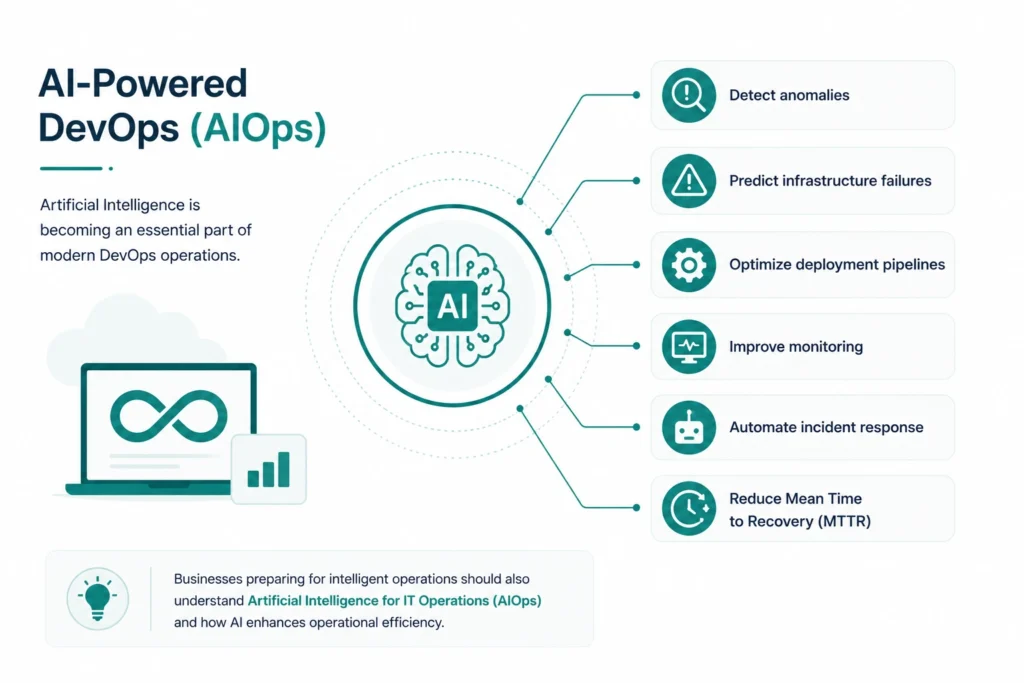
Artificial Intelligence is becoming an essential part of modern DevOps operations.
AI now helps organizations:
- Detect anomalies
- Predict infrastructure failures
- Optimize deployment pipelines
- Improve monitoring
- Automate incident response
- Reduce Mean Time to Recovery (MTTR)
Businesses preparing for intelligent operations should also understand Artificial Intelligence for IT Operations (AIOps) and how AI enhances operational efficiency.
Platform Collaboration Across Hybrid Teams
As remote and hybrid work environments continue to grow, organizations are increasingly relying on cloud-based collaboration platforms, integrated DevOps toolchains, and shared knowledge repositories to maintain productivity across distributed teams.
Successful DevOps cultures prioritize visibility, documentation, and real-time collaboration regardless of where team members are located.
Why Choose MicroGenesis for Your DevOps Transformation?
Building a strong DevOps culture requires more than adopting automation tools or implementing CI/CD pipelines. It requires aligning people, processes, technology, and business objectives into a unified operating model that supports continuous improvement.
MicroGenesis helps organizations build high-performing DevOps consulting services environments by combining technical expertise with proven transformation strategies. Our consultants work closely with businesses to modernize software delivery, strengthen collaboration, automate workflows, and implement cloud-native DevOps practices that drive measurable business outcomes.
Our DevOps capabilities include:
- DevOps consulting and assessment
- CI/CD pipeline implementation
- Infrastructure as Code (IaC)
- DevSecOps integration
- Cloud migration and modernization
- Kubernetes and container orchestration
- DevOps automation
- Enterprise DevOps transformation
- Managed DevOps services
Whether you’re beginning your DevOps journey or scaling enterprise-wide transformation, MicroGenesis provides the expertise needed to accelerate innovation while improving software quality, security, and operational efficiency.
Conclusion
A successful DevOps culture is built on more than tools and automation—it is built on people, collaboration, and a shared commitment to continuous improvement. Organizations that foster open communication, encourage continuous learning, embrace automation, measure meaningful outcomes, and lead with trust create an environment where innovation can thrive.
As software development continues to evolve, organizations that invest in a strong DevOps culture will be better equipped to deliver high-quality software faster, adapt to changing business needs, and maintain a competitive edge. By embedding collaboration, automation, security, and customer-focused thinking into everyday operations, businesses can transform DevOps from a technical initiative into a long-term strategic advantage.
With MicroGenesis as your trusted DevOps partner, you can build a resilient, future-ready DevOps culture that empowers teams, accelerates digital transformation, and delivers measurable business value through modern software delivery practices.


