


Modern software development is undergoing a major transformation. Organizations are expected to deliver applications faster, scale instantly to meet changing demand, and innovate continuously without increasing operational complexity. Traditional infrastructure models often struggle to meet these expectations, requiring teams to spend significant time managing servers, configuring environments, and maintaining infrastructure.
This is why many organizations are embracing serverless computing alongside DevOps.
Serverless computing eliminates the need to manage servers, while DevOps automates software delivery through continuous integration, continuous deployment (CI/CD), Infrastructure as Code (IaC), and collaborative workflows. Together, they enable development teams to focus on building business value instead of managing infrastructure.
The result is a highly agile software delivery model that supports rapid innovation, automatic scalability, reduced operational overhead, and faster time-to-market.
Organizations adopting cloud-native development should also understand how cloud computing enhances DevOps practices to build scalable, resilient, and highly automated software delivery pipelines.
In this guide, we’ll explore how serverless computing complements DevOps, its benefits, implementation strategies, common challenges, and best practices for building modern cloud-native applications.
What Is Serverless Computing?
Despite its name, serverless computing does not eliminate servers. Instead, it removes the responsibility of provisioning, maintaining, patching, and scaling servers from development teams.
Cloud providers automatically manage the underlying infrastructure, allowing developers to focus entirely on writing and deploying application code.
Applications are executed only when triggered by events, making serverless computing highly efficient and cost-effective for many workloads.
Popular serverless platforms include:
- AWS Lambda
- Azure Functions
- Google Cloud Functions
- Cloudflare Workers
- Oracle Functions
Unlike traditional infrastructure, organizations only pay for actual execution time rather than maintaining continuously running servers.
Key Characteristics of Serverless Architecture
Serverless platforms provide several capabilities that make them ideal for modern software development.
Event-Driven Execution
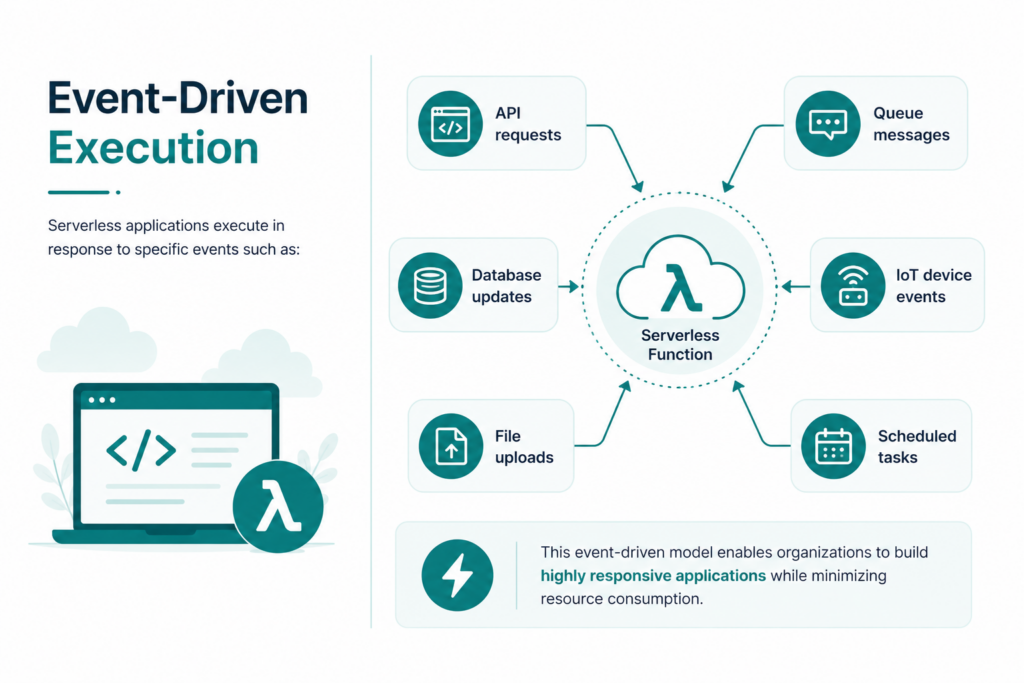 Serverless applications execute in response to specific events such as:
- API requests
- Database updates
- File uploads
- Queue messages
- IoT device events
- Scheduled tasks
This event-driven model enables organizations to build highly responsive applications while minimizing resource consumption.
💡
Automatic Scaling
Serverless platforms automatically increase or decrease computing resources based on workload demand.
Whether processing ten requests or ten million requests, infrastructure scaling occurs automatically without manual intervention.
This makes serverless particularly valuable for applications with unpredictable traffic patterns.
No Infrastructure Management
Developers no longer need to:
- Configure virtual machines
- Patch operating systems
- Manage load balancers
- Configure scaling rules
- Maintain physical infrastructure
Cloud providers handle infrastructure operations, allowing engineering teams to focus entirely on application development.
Pay-As-You-Go Pricing
Traditional infrastructure incurs costs even when applications remain idle.
Serverless platforms charge only for actual execution time and resource consumption.
This pricing model significantly reduces infrastructure costs for workloads with variable or intermittent traffic.
Understanding DevOps
DevOps is a collaborative approach that combines software development and IT operations to accelerate application delivery while improving reliability, security, and quality.
Rather than treating development and operations as separate functions, DevOps promotes shared ownership throughout the software delivery lifecycle.
Core DevOps principles include:
- Continuous Integration (CI)
- Continuous Delivery (CD)
- Infrastructure as Code (IaC)
- Automation
- Continuous Monitoring
- Feedback-driven improvement
- Collaboration across teams
By automating repetitive processes and standardizing workflows, DevOps enables organizations to release software faster while reducing operational risks.
Organizations building modern software delivery pipelines should also explore DevOps automation best practices to improve efficiency and deployment consistency.
Why Serverless and DevOps Work Better Together
Serverless computing naturally complements DevOps because both prioritize automation, agility, scalability, and operational efficiency.
While DevOps accelerates software delivery through automated pipelines, serverless eliminates infrastructure management, allowing teams to focus entirely on application logic.
Together they enable organizations to:
- Deliver applications faster
- Reduce operational overhead
- Automate deployments
- Improve scalability
- Increase deployment frequency
- Accelerate experimentation
- Improve software reliability
- Optimize infrastructure costs
Instead of spending time managing servers, operations teams focus on improving automation, monitoring, security, and application performance.
Benefits of Combining Serverless and DevOps
Faster Time-to-Market
Serverless platforms simplify application deployment by removing infrastructure provisioning from the software delivery process.
Combined with automated CI/CD pipelines, development teams can move new features from development to production in minutes instead of days.
This enables businesses to respond quickly to changing customer expectations and market opportunities.
Simplified Infrastructure Management
Traditional DevOps teams invest considerable effort in maintaining virtual machines, operating systems, container clusters, networking, and scaling policies.
Serverless significantly reduces this operational burden by allowing cloud providers to manage infrastructure automatically.
Organizations can redirect engineering resources toward product innovation instead of infrastructure maintenance.
Better Scalability
One of the biggest advantages of serverless computing is its ability to scale automatically.
Applications respond dynamically to changing workloads without requiring manual capacity planning or infrastructure provisioning.
This enables organizations to maintain high application availability while optimizing cloud resource utilization.
Reduced Operational Costs
Because organizations pay only for actual function execution, serverless architectures can significantly reduce infrastructure expenses compared to traditional always-on servers.
Combined with DevOps automation, businesses also reduce operational costs associated with infrastructure maintenance, deployments, and ongoing system administration.
Organizations modernizing cloud-native applications should also understand migrating to the cloud with DevOps to build efficient and scalable cloud environments.
Improved Developer Productivity
By removing infrastructure management responsibilities, development teams can focus on:
- Writing business logic
- Improving application functionality
- Building new features
- Enhancing user experience
- Delivering software more frequently
This improves engineering productivity while accelerating innovation across the organization.
How a Serverless DevOps Workflow Operates
Unlike traditional application deployment, a serverless DevOps pipeline focuses on deploying small, event-driven functions instead of entire applications. Every stage is automated, enabling development teams to release new features rapidly while maintaining quality and reliability.
Typical Serverless DevOps Workflow
Developer Writes Code
↓
Pushes Code to Git Repository
↓
CI Pipeline Starts Automatically
↓
Build & Automated Testing
↓
Security & Code Quality Scans
↓
Infrastructure Provisioning (IaC)
↓
Deploy to Staging Environment
↓
Automated Validation
↓
Production Deployment
↓
Continuous Monitoring & Feedback
Continuous Integration and Continuous Delivery (CI/CD) for Serverless Applications
CI/CD remains the backbone of every successful DevOps strategy. In serverless environments, CI/CD pipelines automate everything from code validation to production deployment.
What Happens Inside a Serverless CI/CD Pipeline?
| Stage | Purpose |
| Source Control | Developers commit code to Git repositories. |
| Build | Functions are packaged automatically. |
| Automated Testing | Unit, integration, and security tests validate code quality. |
| Infrastructure Deployment | Infrastructure is provisioned using Infrastructure as Code (IaC). |
| Function Deployment | Serverless functions are deployed automatically. |
| Monitoring | Performance, logs, and alerts are continuously monitored. |
This automated approach allows organizations to release updates multiple times per day while reducing deployment risks.
Businesses looking to improve deployment reliability should also explore common CI/CD failures and solutions to identify and prevent pipeline bottlenecks.
Infrastructure as Code (IaC): The Foundation of Serverless Automation
Serverless applications still rely on cloud infrastructure such as API gateways, databases, storage services, event queues, IAM roles, and networking components.
Instead of creating these resources manually, DevOps teams define everything as code.
Popular Infrastructure as Code Tools
- Terraform
- AWS CloudFormation
- AWS CDK
- Azure Bicep
- Pulumi
- Serverless Framework
Why IaC Matters
- Consistent deployments
- Version-controlled infrastructure
- Faster environment provisioning
- Simplified disaster recovery
- Easier compliance audits
Treating infrastructure like application code reduces configuration drift and ensures every environment remains identical.
Event-Driven Architecture: The Core of Serverless Computing
Unlike traditional applications that continuously run on servers, serverless applications execute only when an event occurs.
Common Events That Trigger Serverless Functions
| Event | Example |
| API Request | Customer submits an online form |
| File Upload | Image uploaded to cloud storage |
| Database Change | New customer record created |
| Queue Message | Payment processing request received |
| IoT Event | Sensor sends telemetry |
| Scheduled Event | Nightly report generation |
This event-driven model makes serverless highly efficient because computing resources are consumed only when work needs to be performed.
Monitoring and Observability in Serverless Environments
Serverless applications often consist of hundreds of small functions communicating with multiple cloud services. Without comprehensive monitoring, identifying performance issues becomes extremely difficult.
A modern observability strategy should include:
Infrastructure Monitoring
Monitor cloud services, databases, networking, and storage.
Application Performance Monitoring (APM)
Track:
- Response times
- Execution duration
- Error rates
- Cold starts
- Request latency
Centralized Logging
Aggregate logs from every function into a centralized platform for troubleshooting.
Distributed Tracing
Visualize requests as they move through multiple serverless functions and cloud services.
Organizations building cloud-native applications should also understand cloud and DevOps integration challenges to improve visibility and operational resilience.
Securing Serverless Applications with DevSecOps
Security should be integrated into every stage of the serverless development lifecycle—not added after deployment.
A mature DevSecOps strategy helps organizations identify vulnerabilities before they impact production environments.
Security Best Practices
✔ Scan dependencies automatically
✔ Validate Infrastructure as Code templates
✔ Encrypt sensitive data
✔ Implement least-privilege IAM policies
✔ Store secrets securely
✔ Continuously monitor runtime activity
Cloud-native security automation significantly reduces operational risk while supporting compliance requirements.
Organizations adopting serverless applications should also explore DevSecOps to strengthen application security throughout the software delivery lifecycle.
Popular Tools Used in Serverless DevOps
| Category | Popular Tools |
| Source Control | GitHub, GitLab, Bitbucket |
| CI/CD | GitHub Actions, GitLab CI/CD, Bitbucket Pipelines, CircleCI |
| Infrastructure as Code | Terraform, AWS SAM, AWS CDK, Serverless Framework |
| Containers (Hybrid Deployments) | Docker, Kubernetes |
| Monitoring | AWS CloudWatch, Azure Monitor, Datadog, New Relic |
| Logging | ELK Stack, CloudWatch Logs, Google Cloud Logging |
| Security | Snyk, Aqua Security, Trivy, SonarQube |
Selecting an integrated toolchain simplifies automation while improving collaboration across development, operations, and security teams.
Why Organizations Are Adopting Serverless DevOps
Organizations are increasingly choosing serverless DevOps because it enables them to deliver software faster while reducing operational complexity.
Key Business Benefits
Accelerated software delivery
Release new features more frequently through automated deployment pipelines.
Reduced operational overhead
Eliminate server management and infrastructure maintenance.
Automatic scalability
Scale applications instantly based on user demand.
Lower cloud costs
Pay only for actual function execution rather than idle infrastructure.
Improved security
Integrate automated security checks directly into CI/CD workflows.
Greater developer productivity
Allow engineering teams to focus on building applications instead of managing infrastructure.
As organizations continue adopting cloud-native architectures, serverless computing and DevOps together provide a powerful foundation for building scalable, resilient, and highly automated software delivery platforms.
Challenges of Serverless DevOps (and How to Overcome Them)
While serverless computing simplifies infrastructure management, it also introduces a new set of architectural and operational challenges. Understanding these limitations early allows organizations to design resilient, scalable, and secure serverless applications without sacrificing the speed and agility that DevOps provides.
1. Cold Starts and Performance Latency
One of the most discussed challenges in serverless computing is the cold start.
When a function hasn’t been executed for some time, the cloud provider must initialize a new runtime before processing the request. This startup delay can impact user experience, especially for latency-sensitive applications.
Common Causes
- Infrequently used functions
- Large deployment packages
- Heavy runtime dependencies
- Complex initialization logic
Best Practices
✔ Use lightweight runtimes like Node.js or Go
✔ Minimize package size
✔ Enable Provisioned Concurrency (AWS Lambda)
✔ Keep initialization logic minimal
✔ Separate long-running processes into independent functions
Reducing cold starts improves application responsiveness while maintaining the cost benefits of serverless computing.
2. Debugging Distributed Applications
Traditional applications are often easier to debug because requests follow predictable execution paths.
Serverless applications, however, consist of dozens—or even hundreds—of independent functions communicating through APIs, event buses, message queues, and cloud services.
This distributed architecture makes troubleshooting significantly more complex.
Recommended Solution
Implement:
- Distributed tracing
- Centralized logging
- Correlation IDs
- Real-time dashboards
- End-to-end transaction monitoring
These capabilities help engineers quickly identify failures across multiple services.
3. Vendor Lock-In
Many serverless applications rely heavily on cloud-provider-specific services.
Examples include:
- AWS Lambda
- Azure Functions
- Google Cloud Functions
- AWS DynamoDB
- Azure Event Grid
- AWS Step Functions
Although these services accelerate development, they can make future migrations difficult.
Reduce Vendor Dependency
Organizations can improve portability by:
- Using open standards where possible
- Abstracting cloud-specific services
- Containerizing workloads when appropriate
- Designing loosely coupled architectures
Businesses planning long-term cloud strategies should also understand migrating to the cloud with DevOps to reduce migration risks and improve application portability
4. Local Development Challenges
Testing serverless applications locally is often more difficult than testing traditional applications.
Developers frequently depend on cloud resources such as:
- Event triggers
- Databases
- Storage services
- Authentication
- API Gateways
Replicating these services locally requires additional tooling.
Common Development Tools
- LocalStack
- AWS SAM CLI
- serverless-offline
- Azure Functions Core Tools
Using local emulators allows developers to validate functionality before deploying to cloud environments.
5. Execution Time Limitations
Most serverless platforms enforce maximum execution times.
For example:
| Platform | Maximum Execution Time |
| AWS Lambda | 15 Minutes |
| Azure Functions | Depends on hosting plan |
| Google Cloud Functions | Up to 60 Minutes (Gen 2) |
Long-running workloads such as video processing, machine learning training, or large-scale data analytics may exceed these limits.
Recommended Approach
Use serverless for:
- APIs
- Event processing
- Notifications
- Automation
- Short-lived business processes
Use containers or Kubernetes for long-running workloads.
Organizations combining containers with serverless should also explore containerization in cloud and DevOps environments to build flexible hybrid architectures.
Best Practices for Building Successful Serverless DevOps Platforms
Organizations that successfully implement serverless DevOps consistently follow several industry best practices.
Build Everything as Code
Treat infrastructure exactly like application code.
Version-control:
- Functions
- APIs
- IAM Policies
- Databases
- Networking
- Monitoring
Infrastructure as Code ensures consistent deployments across every environment.
Automate Everything
Automation should extend across the entire software delivery lifecycle.
Automate:
- Testing
- Security validation
- Infrastructure provisioning
- Deployments
- Monitoring
- Rollbacks
Automation reduces manual effort while improving deployment consistency.
Design Stateless Applications
Serverless functions should remain stateless.
Instead of storing application state inside functions, use external services such as:
- Amazon DynamoDB
- Redis
- Azure Cosmos DB
- Google Firestore
Stateless architectures improve scalability and resilience.
Monitor Costs Continuously
Although serverless reduces infrastructure costs, poorly designed applications can generate unexpected cloud expenses.
Monitor:
- Function execution frequency
- Memory allocation
- API requests
- Storage usage
- Network traffic
Continuous optimization ensures predictable cloud spending.
Secure Every Deployment
Every deployment should include automated: c
- Dependency scanning
- Secret validation
- IAM verification
- Infrastructure compliance checks
- Runtime monitoring
Security should remain an integrated component of every CI/CD pipeline.
The Future of Serverless DevOps
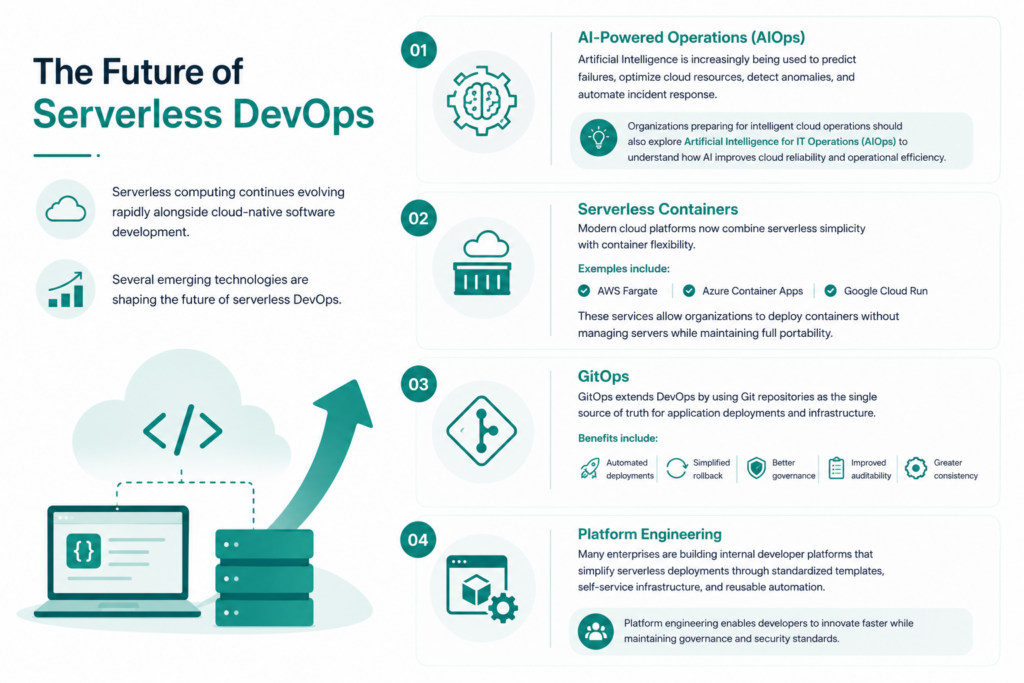
Serverless computing continues evolving rapidly alongside cloud-native software development.
Several emerging technologies are shaping the future of serverless DevOps.
AI-Powered Operations (AIOps)
Artificial Intelligence is increasingly being used to predict failures, optimize cloud resources, detect anomalies, and automate incident response.
Organizations preparing for intelligent cloud operations should also explore Artificial Intelligence for IT Operations (AIOps) to understand how AI improves cloud reliability and operational efficiency
Serverless Containers
Modern cloud platforms now combine serverless simplicity with container flexibility.
Examples include:
- AWS Fargate
- Azure Container Apps
- Google Cloud Run
These services allow organizations to deploy containers without managing servers while maintaining full portability.
GitOps
GitOps extends DevOps by using Git repositories as the single source of truth for application deployments and infrastructure.
Benefits include:
- Automated deployments
- Simplified rollback
- Better governance
- Improved auditability
- Greater consistency
Platform Engineering
Many enterprises are building internal developer platforms that simplify serverless deployments through standardized templates, self-service infrastructure, and reusable automation.
Platform engineering enables developers to innovate faster while maintaining governance and security standards.
Why Choose MicroGenesis for Serverless DevOps?
Adopting serverless architecture requires more than selecting a cloud provider—it requires a well-planned strategy that aligns automation, cloud-native development, security, and DevOps best practices with your business objectives.
MicroGenesis helps organizations design, implement, and optimize serverless DevOps consulting services environments that improve software delivery while reducing operational complexity. Our expertise spans cloud migration, CI/CD automation, Infrastructure as Code (IaC), DevSecOps, Kubernetes, and serverless application modernization, enabling businesses to build scalable, secure, and future-ready cloud platforms.
Our capabilities include:
- Serverless architecture consulting
- Cloud-native application modernization
- CI/CD pipeline implementation
- Infrastructure as Code (IaC)
- DevSecOps integration
- Kubernetes and container orchestration
- Cloud governance and managed DevOps services
By combining deep cloud expertise with proven DevOps methodologies, MicroGenesis helps organizations accelerate innovation, improve operational efficiency, and maximize the value of their cloud investments.
Conclusion
Serverless computing and DevOps are transforming the way modern applications are built, deployed, and managed. Together, they eliminate infrastructure complexity, accelerate software delivery, and enable organizations to build highly scalable, event-driven applications with greater speed and efficiency.
While challenges such as cold starts, distributed debugging, vendor lock-in, and governance require careful planning, adopting best practices around automation, Infrastructure as Code, security, observability, and continuous optimization helps organizations unlock the full potential of serverless architectures.
As technologies such as AI-powered operations, GitOps, serverless containers, and platform engineering continue to mature, serverless DevOps will play an increasingly important role in enabling agile, resilient, and cloud-native software delivery.
With MicroGenesis as your trusted technology partner, you can confidently design and implement scalable serverless DevOps solutions that accelerate innovation, strengthen operational resilience, and support long-term digital transformation.


