


However, adopting cloud and DevOps is not simply about implementing new tools. It requires organizations to rethink their processes, modernize infrastructure, strengthen security, and embrace a culture of continuous improvement. Without a clear strategy, organizations often face fragmented toolchains, operational silos, governance issues, security gaps, and rising cloud costs.
As enterprises increasingly adopt hybrid and multi-cloud environments in 2026, these challenges become even more complex. Successfully integrating cloud and DevOps requires a balanced approach that combines automation, standardized processes, cloud-native technologies, and organizational alignment.
Organizations planning their cloud transformation should first understand how cloud computing enhances DevOps practices and why combining both technologies creates a scalable and resilient software delivery ecosystem.
In this guide, we’ll explore the most common cloud and DevOps integration challenges, practical solutions for overcoming them, and best practices that help organizations build secure, scalable, and future-ready cloud operations.
Why Cloud and DevOps Integration Matters
Cloud computing provides organizations with scalable infrastructure, while DevOps delivers the automation, collaboration, and continuous delivery practices needed to maximize cloud investments.
Together they enable organizations to:
- Accelerate software delivery
- Improve infrastructure scalability
- Automate deployments
- Increase system reliability
- Strengthen collaboration across teams
- Reduce operational costs
- Improve disaster recovery
- Support continuous innovation
However, these benefits can only be realized when cloud infrastructure, development processes, security, and operations work together seamlessly.
Modern organizations increasingly view cloud and DevOps as a unified operating model rather than two independent technologies.
Challenge 1: Toolchain Complexity and Integration
One of the biggest challenges organizations encounter is managing an increasingly complex DevOps toolchain.
As teams adopt different platforms for source control, CI/CD, infrastructure automation, monitoring, security, collaboration, and testing, the number of tools grows rapidly.
Typical enterprise toolchains may include:
- GitHub or GitLab
- Jenkins
- Terraform
- Kubernetes
- Docker
- Prometheus
- Grafana
- SonarQube
- Jira
- Slack
- HashiCorp Vault
While each tool solves a specific problem, managing integrations between dozens of platforms quickly becomes difficult.
Common issues include:
- Duplicate functionality
- Inconsistent workflows
- Data silos
- Complex maintenance
- Increased licensing costs
- Integration failures
Without standardization, development teams spend more time maintaining tools than delivering software.
How to Simplify Your DevOps Toolchain
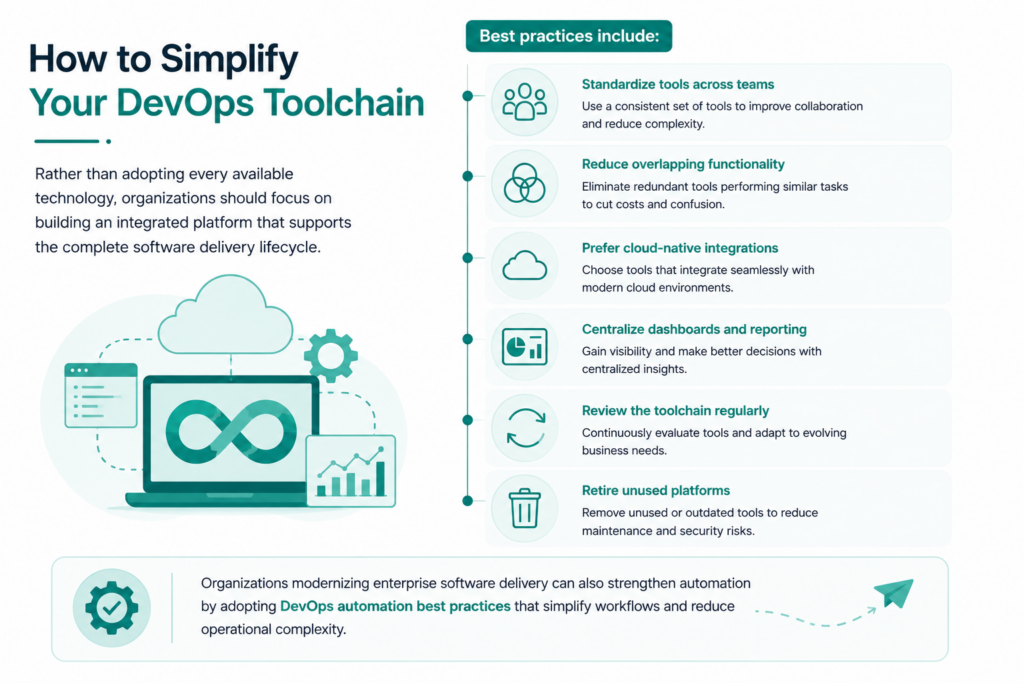
Rather than adopting every available technology, organizations should focus on building an integrated platform that supports the complete software delivery lifecycle.
Best practices include:
- Standardize tools across teams
- Reduce overlapping functionality
- Prefer cloud-native integrations
- Centralize dashboards and reporting
- Review the toolchain regularly
- Retire unused platforms
Organizations modernizing enterprise software delivery can also strengthen automation by adopting DevOps automation best practices that simplify workflows and reduce operational complexity.
Challenge 2: Organizational Silos
Technology alone cannot deliver DevOps success.
Many organizations continue to operate with separate development, operations, QA, infrastructure, and security teams.
These silos often create:
- Slow approvals
- Poor communication
- Delayed releases
- Conflicting priorities
- Limited accountability
- Inefficient incident response
Cloud adoption often magnifies these issues because infrastructure changes occur much more rapidly than traditional IT processes can accommodate.
Without shared ownership, organizations struggle to realize the full value of DevOps.
Building a Collaborative DevOps Culture
Successful cloud-native organizations build cross-functional teams that share responsibility for software delivery.
Key initiatives include:
- Shared sprint planning
- Joint retrospectives
- Common performance metrics
- Cross-functional ownership
- Continuous feedback loops
- Transparent communication
Development, operations, security, and QA teams should work toward shared business objectives rather than departmental goals.
Organizations looking to strengthen collaboration should also implement DevOps culture best practices that promote transparency, shared ownership, and continuous improvement.
Challenge 3: Security in Cloud-Native DevOps
As deployment frequency increases, security risks also grow.
Cloud-native environments introduce new attack surfaces including:
- Containers
- APIs
- Infrastructure as Code
- Kubernetes clusters
- Serverless workloads
- Third-party dependencies
Traditional security reviews performed only before production deployment are no longer sufficient.
Organizations must integrate security directly into their DevOps pipelines.
Shift Left with DevSecOps
DevSecOps embeds security throughout the software development lifecycle instead of treating it as a final checkpoint.
A mature DevSecOps strategy includes:
- Automated vulnerability scanning
- Dependency analysis
- Infrastructure security validation
- Secret management
- Compliance automation
- Identity and Access Management (IAM)
- Container image scanning
- Policy-as-Code
By detecting vulnerabilities early, organizations reduce remediation costs while improving compliance and application security.
Businesses strengthening cloud security should also explore DevSecOps to understand how security automation improves software quality and reduces deployment risks.
Why Security Cannot Be an Afterthought
Modern cloud environments are highly dynamic.
Infrastructure changes continuously through automation, containers are created and destroyed within seconds, and applications may be deployed multiple times each day.
Security practices must evolve accordingly.
Instead of relying solely on manual reviews, organizations should automate:
- Compliance checks
- Infrastructure validation
- Secrets management
- Container scanning
- Runtime monitoring
- Security policy enforcement
Embedding security into every stage of software delivery enables organizations to innovate rapidly without compromising governance or customer trust.
Challenge 4: Limited Observability Across Cloud Environments
As organizations move toward microservices, containers, Kubernetes, and multi-cloud architectures, monitoring becomes significantly more complex. Traditional infrastructure monitoring is no longer sufficient because applications are distributed across multiple services, cloud regions, and platforms.
Without complete visibility, teams struggle to identify performance bottlenecks, troubleshoot incidents, and maintain application reliability.
Common issues include:
- Incomplete application visibility
- Delayed incident detection
- Difficult root cause analysis
- Poor user experience monitoring
- Alert fatigue caused by excessive notifications
When observability is lacking, even small performance issues can escalate into major production outages.
How to Build an Effective Observability Strategy
Modern DevOps teams should implement a comprehensive observability framework that combines metrics, logs, traces, and application performance monitoring.
A complete observability solution includes:
Infrastructure Monitoring
Monitor servers, virtual machines, Kubernetes clusters, storage, databases, and networking resources.
Application Performance Monitoring (APM)
Track application response times, latency, availability, throughput, and transaction performance.
Centralized Logging
Collect logs from applications, containers, cloud services, and infrastructure into a centralized platform for easier troubleshooting.
Distributed Tracing
Visualize requests as they move across multiple microservices to identify performance bottlenecks and dependency failures.
Organizations operating hybrid environments should also explore optimizing IT operations in hybrid and multi-cloud environments to improve operational visibility and simplify cloud management.
Challenge 5: Managing Infrastructure as Code at Scale
Infrastructure as Code (IaC) has become a core DevOps practice, allowing organizations to provision infrastructure automatically using tools such as Terraform, AWS CloudFormation, Azure Resource Manager, and Ansible.
However, as cloud environments grow, infrastructure code also becomes increasingly complex.
Common challenges include:
- Large Terraform codebases
- Duplicate infrastructure templates
- Configuration drift
- Inconsistent environments
- Manual infrastructure changes
- Poor documentation
Without proper governance, Infrastructure as Code can become just as difficult to maintain as traditional infrastructure.
Best Practices for Infrastructure as Code
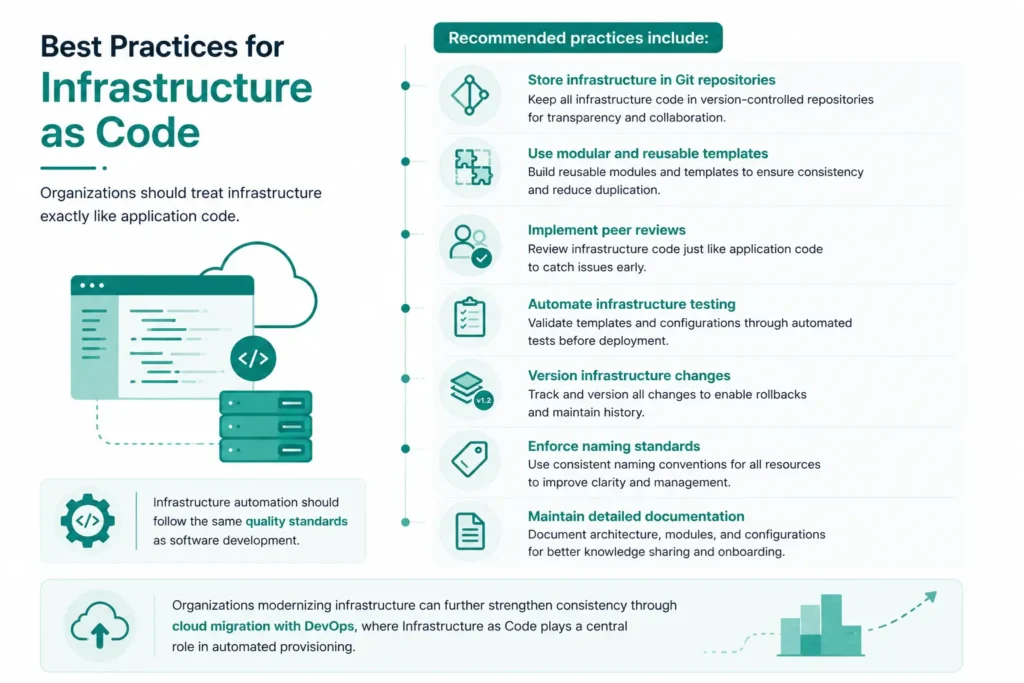 Organizations should treat infrastructure exactly like application code.
Recommended practices include:
- Store infrastructure in Git repositories
- Use modular and reusable templates
- Implement peer reviews
- Automate infrastructure testing
- Version infrastructure changes
- Enforce naming standards
- Maintain detailed documentation
Infrastructure automation should follow the same quality standards as software development.
Organizations modernizing infrastructure can further strengthen consistency through cloud migration with DevOps, where Infrastructure as Code plays a central role in automated provisioning.
Challenge 6: Cloud Cost Management and Resource Sprawl
Cloud computing provides unmatched flexibility, but without proper governance, organizations often experience rapidly increasing operational costs.
Common causes include:
- Idle virtual machines
- Unused storage volumes
- Oversized compute resources
- Forgotten development environments
- Duplicate cloud services
- Poor auto-scaling configurations
Because cloud infrastructure can be provisioned instantly, unmanaged environments often grow much faster than expected.
Implement FinOps Practices
Modern organizations increasingly adopt FinOps—a financial management discipline that brings engineering, operations, and finance teams together to optimize cloud spending.
Successful FinOps strategies include:
- Resource tagging
- Budget alerts
- Cost dashboards
- Reserved instances
- Rightsizing workloads
- Automatic shutdown schedules
- Continuous usage reviews
Cloud cost optimization should become a continuous operational process rather than a one-time exercise.
By combining automation with financial accountability, organizations can maximize cloud ROI while maintaining operational agility.
Challenge 7: Modernizing Legacy Applications
Many enterprises continue to rely on legacy applications that were never designed for cloud-native environments.
These systems often present challenges such as:
- Monolithic architectures
- Outdated programming languages
- Manual deployment processes
- Tight application dependencies
- Limited scalability
Simply moving these applications to the cloud rarely delivers the expected business benefits.
Modernization Strategies
Organizations should evaluate each workload individually before migration.
Common approaches include:
Rehost
Move applications with minimal modifications.
Replatform
Optimize applications while retaining the core architecture.
Refactor
Redesign applications using cloud-native services, containers, or microservices.
Replace
Adopt SaaS platforms where appropriate.
Containers are often used to simplify legacy modernization by packaging applications into portable environments that can run consistently across different cloud platforms.
Organizations modernizing legacy systems should also understand containerization in cloud and DevOps environments and how containers simplify application migration.
Challenge 8: Skills Gap and Workforce Readiness
Technology evolves much faster than traditional IT skill development.
Cloud computing, Kubernetes, Infrastructure as Code, DevSecOps, GitOps, automation, and AI-driven operations all require specialized expertise.
Many organizations struggle with:
- Limited cloud expertise
- Lack of DevOps experience
- Skills shortages
- Difficulty hiring experienced engineers
- Resistance to learning new technologies
Without proper training, even the best technology investments fail to deliver expected outcomes.
Building Cloud and DevOps Skills
Successful organizations prioritize continuous learning.
Effective initiatives include:
- Internal training programs
- Cloud certifications
- Hands-on labs
- Cross-functional mentoring
- Technical communities of practice
- Internal knowledge-sharing sessions
Continuous learning helps teams adapt to changing technologies while reducing dependency on individual experts.
Organizations should also encourage developers, operations engineers, and security teams to collaborate on shared cloud projects, accelerating knowledge transfer and fostering a culture of continuous improvement.
Building a Sustainable Cloud and DevOps Strategy
Successfully integrating cloud and DevOps requires more than solving isolated technical challenges.
Organizations should focus on building a long-term strategy centered around:
- Standardized automation
- Infrastructure consistency
- Security by design
- Cross-functional collaboration
- Continuous monitoring
- Governance
- Continuous learning
By addressing these foundational areas early, businesses can reduce operational complexity while creating scalable, resilient, and future-ready cloud environments.
Challenge 9: Governance and Compliance Across Cloud Environments
As organizations expand their cloud footprint, maintaining governance and regulatory compliance becomes increasingly challenging. Multiple cloud providers, distributed teams, and rapidly changing infrastructure can create inconsistencies that lead to security vulnerabilities, compliance failures, and operational risks.
Without a well-defined governance framework, organizations often struggle with:
- Inconsistent resource naming conventions
- Uncontrolled infrastructure provisioning
- Lack of policy enforcement
- Shadow IT
- Compliance violations
- Difficulty tracking cloud assets
Cloud governance is not about limiting innovation—it is about creating standardized processes that enable teams to innovate securely and responsibly.
Building a Strong Governance Framework
Successful organizations establish governance from the beginning of their cloud journey rather than treating it as an afterthought.
Key governance practices include:
- Define cloud usage policies
- Standardize naming conventions
- Implement Role-Based Access Control (RBAC)
- Apply resource tagging standards
- Automate compliance checks
- Enforce Infrastructure as Code policies
- Conduct regular governance reviews
Automation plays a critical role in governance by continuously validating cloud resources against organizational policies and regulatory requirements.
Challenge 10: Resistance to Organizational Change
While technology is often the focus of cloud transformation initiatives, people remain the most important factor in long-term success.
Many cloud and DevOps initiatives struggle because teams are hesitant to adopt new tools, processes, or responsibilities.
Common concerns include:
- Fear of automation replacing jobs
- Resistance to new workflows
- Limited executive sponsorship
- Unclear responsibilities
- Lack of confidence in new technologies
Successfully adopting cloud and DevOps requires cultural transformation alongside technical modernization.
Creating a Culture of Continuous Improvement
Organizations should approach cloud and DevOps adoption as a business transformation initiative rather than simply a technology upgrade.
Successful strategies include:
- Start with small pilot projects
- Demonstrate measurable business value
- Celebrate early successes
- Encourage experimentation
- Invest in continuous learning
- Build internal DevOps champions
- Maintain executive support throughout the transformation
Organizations that embrace continuous improvement adapt more quickly to changing technologies while maintaining higher employee engagement.
Best Practices for Successful Cloud and DevOps Integration
Organizations that consistently succeed with cloud-native DevOps share several common practices.
Standardize Automation
Automate infrastructure provisioning, deployments, testing, monitoring, and security wherever possible.
Standardization reduces manual effort while improving consistency across environments.
Adopt Cloud-Native Architectures
Design applications specifically for cloud environments rather than simply migrating legacy systems.
Cloud-native architectures provide:
- Better scalability
- Higher availability
- Improved resilience
- Easier maintenance
- Faster deployments
Integrate Security from Day One
Security should be embedded throughout the software delivery lifecycle.
Automate:
- Security scanning
- Compliance validation
- Secret management
- Infrastructure security
- Runtime protection
This proactive approach reduces risk while supporting faster software delivery.
Monitor Continuously
Collect metrics, logs, traces, and infrastructure telemetry to maintain complete visibility into cloud operations.
Continuous monitoring enables faster incident response and ongoing performance optimization.
Build Cross-Functional Teams
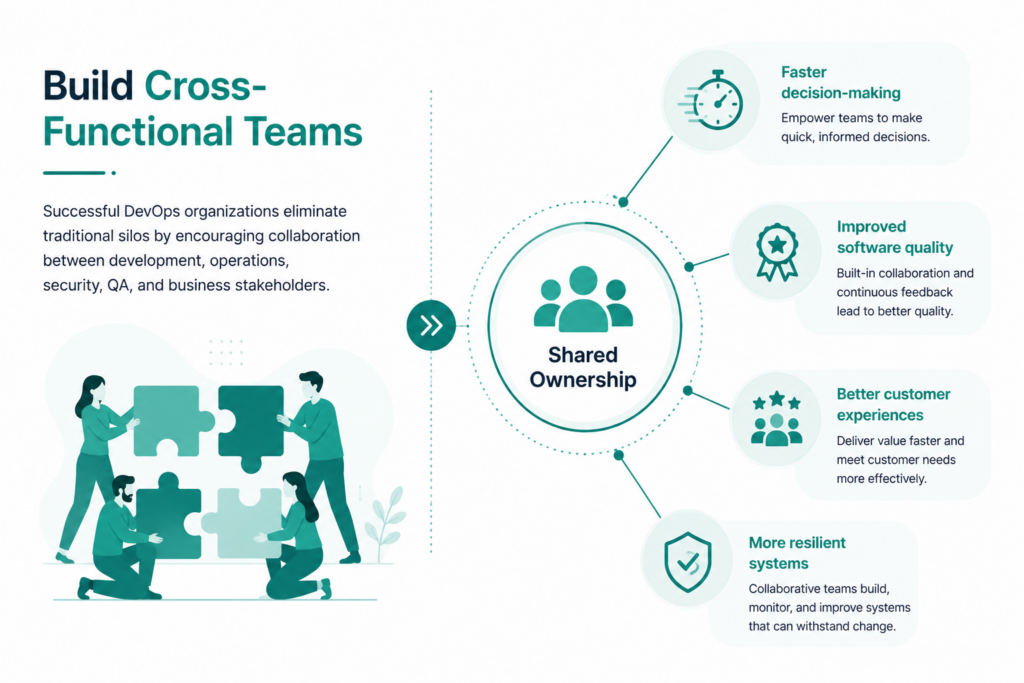
Successful DevOps organizations eliminate traditional silos by encouraging collaboration between development, operations, security, QA, and business stakeholders.
Shared ownership leads to:
- Faster decision-making
- Improved software quality
- Better customer experiences
- More resilient systems
Future Trends Shaping Cloud and DevOps Integration
Cloud and DevOps continue to evolve as organizations embrace automation, artificial intelligence, and cloud-native technologies.
Several trends are expected to shape enterprise software delivery in the coming years.
GitOps
GitOps extends DevOps by using Git repositories as the single source of truth for both applications and infrastructure.
Benefits include:
- Automated deployments
- Better version control
- Simplified rollback
- Improved auditability
- Greater operational consistency
Platform Engineering
Platform engineering provides developers with standardized self-service platforms that simplify infrastructure provisioning and application deployment.
Rather than building infrastructure individually, development teams consume reusable platform services, improving productivity while maintaining governance.
Artificial Intelligence for IT Operations (AIOps)
Artificial intelligence is becoming an essential component of modern cloud operations.
AIOps enables organizations to:
- Predict infrastructure failures
- Detect anomalies automatically
- Optimize cloud resources
- Accelerate root cause analysis
- Reduce operational downtime
Businesses preparing for intelligent cloud operations should also explore Artificial Intelligence for IT Operations (AIOps) to understand how AI enhances operational efficiency and proactive incident management.
Serverless Computing
Organizations are increasingly adopting serverless platforms to reduce infrastructure management and improve scalability.
Serverless architectures automatically provision resources, allowing developers to focus entirely on application development while cloud providers manage the underlying infrastructure.
Businesses adopting cloud-native application development should also understand serverless architectures and DevOps to simplify deployments and improve operational efficiency.
Why Choose MicroGenesis for Cloud and DevOps Transformation?
Successfully integrating cloud computing with DevOps requires more than selecting the right technologies. Organizations need a trusted partner that understands cloud architecture, automation, security, governance, and enterprise software delivery.
MicroGenesis provides DevOps consulting services to help organizations modernize their IT operations by designing scalable cloud strategies aligned with business objectives. Our experts combine deep expertise in cloud platforms, DevOps consulting, Infrastructure as Code (IaC), CI/CD automation, Kubernetes, DevSecOps, and cloud governance. Through our DevOps implementation services, we help businesses accelerate digital transformation while minimizing operational risk.
Our capabilities include:
- Cloud readiness assessments
- Cloud migration and modernization
- DevOps consulting and implementation
- CI/CD pipeline automation
- Infrastructure as Code (IaC)
- Kubernetes and container orchestration
- DevSecOps integration
- Cloud governance and compliance
- Managed cloud and DevOps services
Whether you’re beginning your cloud journey or optimizing an existing DevOps ecosystem, MicroGenesis provides the expertise needed to build secure, scalable, and future-ready cloud environments.
Conclusion
Cloud computing and DevOps have fundamentally changed how organizations build, deploy, and manage modern applications. While integrating these technologies offers significant benefits—including faster software delivery, improved scalability, enhanced collaboration, and greater operational resilience—it also introduces technical, organizational, and governance challenges that require careful planning.
By addressing common obstacles such as toolchain complexity, security, Infrastructure as Code management, cloud cost optimization, observability, governance, and workforce readiness, organizations can create a strong foundation for long-term success. Embracing automation, cloud-native architectures, continuous monitoring, and a culture of collaboration enables businesses to maximize the value of their cloud investments while remaining agile in an increasingly competitive digital landscape.
With MicroGenesis as your trusted cloud and DevOps partner, you can confidently overcome integration challenges, streamline software delivery, strengthen cloud governance, and accelerate your digital transformation with scalable, secure, and future-ready solutions.


