


In today’s digital-first economy, IT infrastructure has become the backbone of every successful enterprise. Whether it’s delivering seamless customer experiences, supporting remote workforces, enabling cloud-native applications, or securing sensitive business data, organizations depend on resilient IT systems to keep operations running without interruption.
However, modern IT environments are far more complex than traditional data centers. Enterprises now operate across hybrid cloud environments, edge locations, SaaS platforms, containers, and distributed applications while facing growing cybersecurity threats, stricter compliance requirements, and ever-increasing customer expectations.
A single infrastructure outage today can result in:
- Significant revenue loss
- Business disruption
- Customer dissatisfaction
- Compliance violations
- Reputational damage
- Reduced employee productivity
According to multiple industry reports, even a few minutes of downtime can cost large enterprises thousands—or even millions—of dollars depending on the industry.
This is why resilience has become more than an IT objective—it’s now a business strategy.
A resilient IT infrastructure not only withstands disruptions but also adapts, recovers quickly, and continuously improves. It enables organizations to maintain business continuity, ensure high availability, strengthen cybersecurity, and support innovation without compromising performance.
More importantly, resilience isn’t achieved through infrastructure alone. Modern organizations increasingly rely on IT service management services to combine infrastructure, processes, automation, governance, and people into a unified operational model. By integrating resilience with mature ITSM practices, businesses can proactively manage incidents, reduce downtime, improve service delivery, and build a future-ready digital enterprise.
In this comprehensive guide, we’ll explore the essential pillars of resilient IT infrastructure, architectural best practices, cloud strategies, automation, cybersecurity, emerging technologies, and how ITSM consulting services help organizations build infrastructure that is secure, scalable, and ready for the future.
Why Resilient IT Infrastructure Matters More Than Ever
Technology disruptions are no longer rare events.
Organizations today face an increasing number of challenges, including:
- Cyberattacks and ransomware
- Hardware failures
- Software defects
- Human error
- Cloud service outages
- Network disruptions
- Natural disasters
- Increasing compliance requirements
At the same time, customer expectations have never been higher.
Users expect:
- 24×7 service availability
- Instant application performance
- Secure digital experiences
- Zero downtime
- Rapid issue resolution
Failure to meet these expectations directly impacts revenue, customer loyalty, and competitive advantage.
Resilience enables organizations to continue delivering business services—even when unexpected events occur.
Instead of reacting to failures, resilient organizations anticipate, withstand, recover, and continuously improve.
What Is IT Infrastructure Resilience?
IT infrastructure resilience refers to an organization’s ability to maintain the availability, performance, security, and recoverability of its technology ecosystem during and after disruptions.
Unlike traditional infrastructure management—which primarily focuses on uptime—resilience emphasizes adaptability.
A resilient infrastructure can:
- Detect problems early
- Minimize service disruptions
- Automatically recover from failures
- Protect business-critical data
- Scale with changing business demands
- Continuously optimize performance
Simply put:
Resilience isn’t about preventing every failure—it’s about ensuring your business continues operating when failures inevitably occur.
The Business Impact of Infrastructure Resilience
Organizations investing in resilient infrastructure consistently achieve measurable business benefits.
|
Business Challenge |
How Resilient Infrastructure Helps |
|
Service outages |
Automated failover minimizes downtime |
|
Cybersecurity threats |
Continuous monitoring and Zero Trust reduce risk |
|
Business growth |
Elastic infrastructure supports rapid scaling |
|
Compliance |
Improved governance and audit readiness |
|
Customer experience |
Higher service availability and performance |
|
Operational efficiency |
Automation reduces manual intervention |
Beyond technology, resilient infrastructure directly contributes to business continuity, customer trust, and long-term profitability.
The Five Core Pillars of IT Infrastructure Resilience
Building resilient infrastructure requires balancing multiple capabilities rather than relying on a single technology.
The following pillars form the foundation of every resilient digital enterprise.
Availability
Availability ensures that business applications, services, and infrastructure remain accessible whenever users need them.
Modern enterprises cannot afford prolonged outages, especially when customers expect services to be available around the clock.
High availability is achieved through:
- Redundant infrastructure
- Load balancing
- Failover clustering
- Multi-region deployments
- Disaster recovery planning
For example, cloud providers distribute workloads across multiple availability zones so that if one region experiences an outage, services automatically continue operating from another location.
The objective is simple:
No single point of failure.
Reliability
Availability means systems are online.
Reliability means they consistently perform as expected.
Reliable infrastructure delivers predictable performance under both normal operations and peak workloads.
Organizations improve reliability through:
- Preventive maintenance
- Capacity planning
- Performance monitoring
- Automated patch management
- Infrastructure standardization
Reliable systems reduce unexpected incidents while improving user satisfaction and operational efficiency.
Scalability
Business demands rarely remain constant.
Traffic spikes.
Customer demand changes.
Applications evolve.
Infrastructure must adapt without requiring major redesigns.
Modern infrastructure achieves scalability through:
- Cloud elasticity
- Auto-scaling
- Container orchestration
- Virtualization
- Software-defined infrastructure
For example, an e-commerce platform experiencing Black Friday traffic can automatically provision additional computing resources without manual intervention.
Scalability allows organizations to grow without sacrificing performance.
Security
Cyber resilience is now inseparable from infrastructure resilience.
Today’s enterprises face increasingly sophisticated threats, including:
- Ransomware
- Phishing attacks
- Insider threats
- Supply chain attacks
- Zero-day vulnerabilities
Modern infrastructure must incorporate security at every layer.
Key security capabilities include:
✔ Identity and Access Management (IAM)
✔ Multi-Factor Authentication (MFA)
✔ Encryption
✔ Endpoint Detection and Response (EDR)
✔ Continuous monitoring
✔ Threat intelligence
✔ Zero Trust Architecture
Rather than treating security as an isolated function, organizations increasingly integrate cybersecurity with IT service management solutions, enabling faster incident response, improved governance, and stronger operational resilience.
Recoverability
No infrastructure is immune to failure.
The true measure of resilience is how quickly systems recover.
Recoverability focuses on restoring business operations while minimizing data loss.
Critical recovery strategies include:
- Automated backups
- Disaster Recovery (DR)
- Business Continuity Planning (BCP)
- Data replication
- Recovery automation
- Recovery testing
Key metrics include:
- Recovery Time Objective (RTO)
- Recovery Point Objective (RPO)
- Mean Time to Recovery (MTTR)
Organizations should regularly test recovery plans rather than assuming backups will work when needed.
The Modern IT Infrastructure Landscape
Today’s enterprise infrastructure looks dramatically different from traditional on-premises environments.
Instead of operating from a single data center, organizations now manage highly distributed ecosystems.
Typical enterprise environments include:
On-Premises Infrastructure
│
▼
Private Cloud
│
▼
Public Cloud
│
▼
SaaS Applications
│
▼
Edge Devices
│
▼
Remote Workforce
Managing these diverse environments requires unified visibility, standardized governance, automation, and mature ITSM consulting practices.
Hybrid and Multi-Cloud Environments
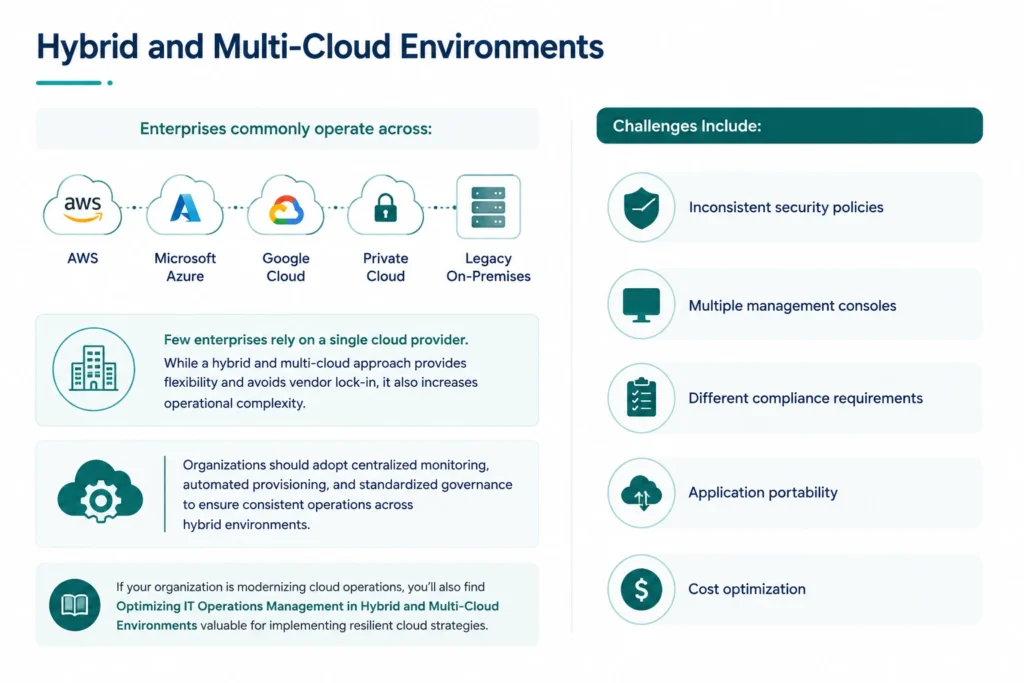
Few enterprises rely on a single cloud provider.
Instead, organizations commonly operate across:
- AWS
- Microsoft Azure
- Google Cloud
- Private cloud
- Legacy on-premises infrastructure
While this approach provides flexibility and avoids vendor lock-in, it also increases operational complexity.
Challenges include:
- Inconsistent security policies
- Multiple management consoles
- Different compliance requirements
- Application portability
- Cost optimization
Organizations should adopt centralized monitoring, automated provisioning, and standardized governance to ensure consistent operations across hybrid environments.
If your organization is modernizing cloud operations, you’ll also find Optimizing IT Operations Management in Hybrid and Multi-Cloud Environments valuable for implementing resilient cloud strategies.
Software-Defined Infrastructure (SDI)
Modern enterprises increasingly replace hardware-centric infrastructure with software-defined technologies.
Examples include:
- Software-Defined Networking (SDN)
- Software-Defined Storage (SDS)
- Software-Defined Data Centers (SDDC)
Benefits include:
- Faster provisioning
- Infrastructure automation
- Reduced manual configuration
- Improved scalability
- Greater operational consistency
Combined with IT service management consulting, software-defined infrastructure significantly improves operational resilience while reducing infrastructure complexity.
Essential Strategies for Building a Resilient IT Infrastructure
Building resilience isn’t about investing in a single technology—it’s about creating an ecosystem where infrastructure, security, automation, monitoring, and service management work together seamlessly. Organizations that adopt a proactive approach are far better equipped to handle disruptions while maintaining business continuity.
Below are the key strategies every digital enterprise should implement.
Design for High Availability
High availability (HA) ensures that applications and services remain operational even when hardware, software, or network components fail.
Instead of relying on a single server or data center, resilient organizations distribute workloads across multiple systems, regions, or cloud availability zones.
Best Practices
- Deploy redundant servers and storage.
- Use load balancers to distribute traffic efficiently.
- Configure automatic failover mechanisms.
- Eliminate single points of failure.
- Replicate critical databases across regions.
Build Security into Every Layer
Cyber resilience is no longer optional.
As enterprises adopt hybrid work, cloud-native applications, and distributed infrastructure, attack surfaces continue to expand.
Rather than treating security as a separate initiative, organizations should integrate it into every layer of infrastructure.
Core Security Components
- Identity and Access Management (IAM)
- Multi-Factor Authentication (MFA)
- Zero Trust Architecture
- Endpoint Detection & Response (EDR)
- Security Information and Event Management (SIEM)
- Encryption at rest and in transit
- Vulnerability management
- Continuous compliance monitoring
Security should be embedded throughout the infrastructure lifecycle—from provisioning and configuration to monitoring and incident response.
Organizations implementing IT service management solutions often integrate security operations directly into service management workflows, enabling faster incident resolution and improved governance.
For a deeper understanding of modern cybersecurity frameworks, explore Zero Trust Security Architecture: A Practical Guide for IT Leaders.
Embrace Infrastructure Automation
Manual infrastructure management increases the risk of configuration errors, deployment delays, and operational inefficiencies.
Automation eliminates repetitive tasks while improving consistency and scalability.
Areas to Automate
- Infrastructure provisioning
- Configuration management
- Patch deployment
- Backup scheduling
- Disaster recovery
- Compliance validation
- Resource scaling
Popular automation technologies include:
- Terraform
- Ansible
- Puppet
- Chef
- Kubernetes
- Azure Automation
- AWS CloudFormation
Benefits
✔ Faster deployments
✔ Reduced human error
✔ Improved compliance
✔ Consistent environments
✔ Lower operational costs
Automation is also a foundational capability for organizations investing in ITSM consulting services, where standardized workflows improve service quality and operational resilience.
Strengthen Disaster Recovery and Business Continuity
Disruptions are inevitable.
What separates resilient organizations from others is how quickly they recover.
A comprehensive disaster recovery (DR) strategy minimizes downtime while protecting business-critical information.
Key Components
Data Backup
Implement automated, encrypted backups stored across multiple geographic locations.
Disaster Recovery Sites
Maintain secondary environments capable of taking over during outages.
Business Continuity Planning
Document procedures for maintaining essential business operations during emergencies.
Regular Testing
Recovery plans should be tested frequently—not only documented.
Organizations should regularly evaluate:
- Recovery Time Objective (RTO)
- Recovery Point Objective (RPO)
- Mean Time to Recovery (MTTR)
Without testing, recovery plans often fail when they are needed most.
Improve Visibility Through Observability
You can’t protect what you can’t see.
Modern IT environments generate enormous volumes of operational data every second.
Observability enables organizations to monitor infrastructure health, detect anomalies, and resolve issues before they affect users.
Modern Observability Includes
- Infrastructure metrics
- Application performance monitoring (APM)
- Centralized logging
- Distributed tracing
- Event correlation
- AI-powered anomaly detection
Typical observability stack:
Infrastructure
│
▼
Metrics • Logs • Traces
│
▼
Observability Platform
│
▼
Dashboards & Alerts
│
▼
Incident Response
Rather than reacting to outages, operations teams gain real-time visibility into system health.
Organizations looking to modernize operations can also explore Artificial Intelligence for IT Operations (AIOps): The Future of Intelligent IT Operations Management, which explains how AI is transforming monitoring and predictive operations.
The Role of IT Service Management in Infrastructure Resilience
Technology alone cannot create resilience.
Processes, governance, and service delivery play equally important roles.
This is where IT service management services become essential.
A mature ITSM framework helps organizations:
- Standardize incident management
- Accelerate problem resolution
- Improve change management
- Reduce service disruptions
- Automate routine requests
- Improve service visibility
- Strengthen governance
Instead of managing infrastructure reactively, IT teams operate with standardized processes that support continuous improvement.
How ITSM Supports Resilience
|
ITSM Practice |
Infrastructure Benefit |
|
Incident Management |
Faster issue resolution |
|
Problem Management |
Eliminates recurring failures |
|
Change Management |
Reduces deployment risk |
|
Configuration Management |
Improves infrastructure visibility |
|
Asset Management |
Optimizes technology investments |
|
Knowledge Management |
Accelerates troubleshooting |
|
Service Request Management |
Improves operational efficiency |
Organizations that combine resilient infrastructure with mature IT service management consulting consistently experience lower downtime, faster recovery, and improved service quality.
Best Practices for Building Long-Term Infrastructure Resilience
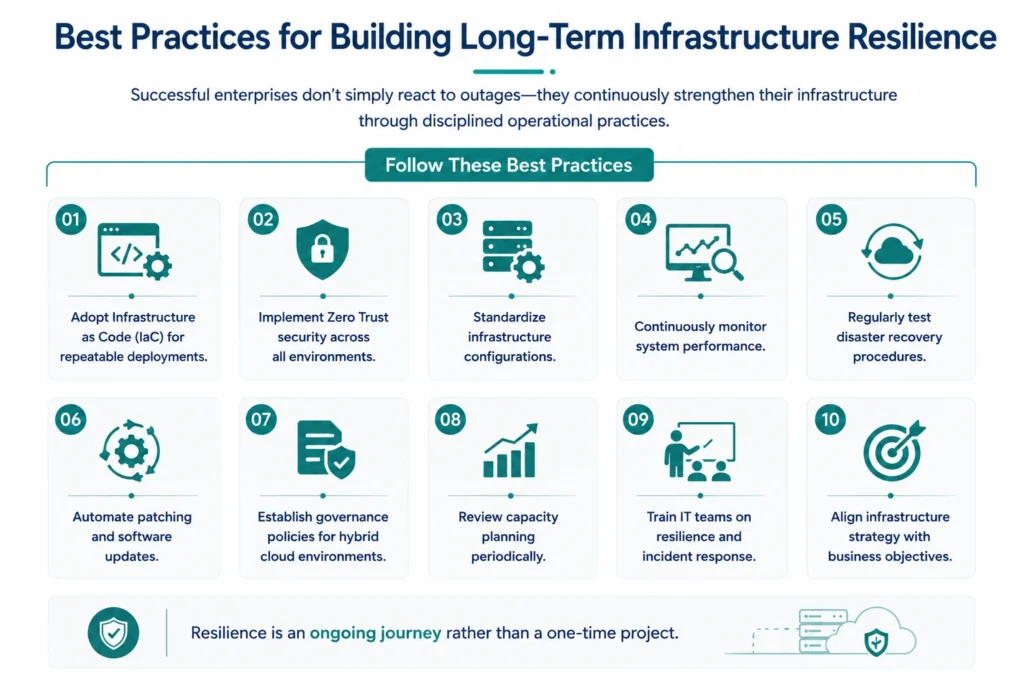
Successful enterprises don’t simply react to outages—they continuously strengthen their infrastructure through disciplined operational practices.
Follow These Best Practices
- Adopt Infrastructure as Code (IaC) for repeatable deployments.
- Implement Zero Trust security across all environments.
- Standardize infrastructure configurations.
- Continuously monitor system performance.
- Regularly test disaster recovery procedures.
- Automate patching and software updates.
- Establish governance policies for hybrid cloud environments.
- Review capacity planning periodically.
- Train IT teams on resilience and incident response.
- Align infrastructure strategy with business objectives.
Resilience is an ongoing journey rather than a one-time project.
Common Mistakes That Undermine Infrastructure Resilience
Even organizations with modern technologies can struggle if foundational practices are overlooked.
Avoid These Common Pitfalls
❌ Treating disaster recovery as a backup strategy only
❌ Delaying software updates and patch management
❌ Ignoring infrastructure documentation
❌ Operating without centralized monitoring
❌ Managing cloud environments in silos
❌ Underestimating cybersecurity risks
❌ Failing to automate repetitive operational tasks
❌ Lack of standardized change management
Many of these issues can be addressed by implementing proven ITSM consulting practices that improve governance, visibility, and operational consistency.
Measuring Infrastructure Resilience
To continuously improve resilience, organizations should track meaningful performance indicators.
Key Metrics
|
KPI |
Why It Matters |
|
System Availability |
Measures service uptime |
|
Mean Time to Detect (MTTD) |
Speed of identifying incidents |
|
Mean Time to Recovery (MTTR) |
Recovery efficiency |
|
Recovery Time Objective (RTO) |
Business continuity readiness |
|
Recovery Point Objective (RPO) |
Data recovery capability |
|
Change Failure Rate |
Deployment reliability |
|
Incident Volume |
Operational stability |
|
Infrastructure Utilization |
Resource optimization |
These KPIs provide actionable insights that help organizations identify weaknesses and prioritize improvements.
Emerging Technologies Shaping Resilient IT Infrastructure
As digital transformation accelerates, resilience is no longer achieved through redundancy alone. Organizations are increasingly leveraging intelligent technologies that enable infrastructure to predict failures, automate recovery, optimize resources, and continuously improve operational performance.
The following technologies are defining the future of resilient IT infrastructure.
Artificial Intelligence for IT Operations (AIOps)
Traditional monitoring tools generate thousands of alerts every day, making it difficult for IT teams to identify genuine incidents.
AIOps uses Artificial Intelligence and Machine Learning to transform operational data into actionable insights.
Instead of simply detecting issues, AIOps can:
- Predict infrastructure failures before they occur
- Correlate events from multiple monitoring tools
- Identify root causes faster
- Automate incident resolution
- Reduce alert fatigue
- Improve service availability
Benefits of AIOps
✔ Faster incident detection
✔ Reduced Mean Time to Resolution (MTTR)
✔ Improved operational efficiency
✔ Predictive maintenance
✔ Intelligent capacity planning
Organizations adopting IT service management solutions increasingly integrate AIOps into their service desks to create proactive, self-healing IT environments.
If you’re exploring intelligent operations, Benefits & Challenges of AI in ITSM provides valuable insights into how AI is reshaping modern service management.
Cloud-Native Infrastructure
Cloud-native architectures have fundamentally changed how resilient applications are designed and deployed.
Instead of relying on monolithic systems, organizations build applications using:
- Containers
- Kubernetes
- Microservices
- Serverless computing
- Service Mesh
These technologies enable applications to recover automatically from failures while scaling dynamically based on demand.
Advantages
- Rapid deployment
- Automatic scaling
- Built-in redundancy
- Improved portability
- Faster disaster recovery
Cloud-native infrastructure also supports continuous innovation without compromising reliability.
Edge Computing
With the growth of IoT, manufacturing, healthcare, and smart cities, processing data closer to where it’s generated has become increasingly important.
Edge computing reduces latency while improving service availability even when connectivity to central cloud environments is disrupted.
Typical edge workloads include:
- Industrial automation
- Smart factories
- Retail analytics
- Autonomous vehicles
- Remote healthcare monitoring
Edge infrastructure complements centralized cloud environments to create highly resilient distributed architectures.
Infrastructure as Code (IaC)
Infrastructure should be managed just like software.
Infrastructure as Code allows organizations to provision and maintain environments through version-controlled code rather than manual configuration.
Popular IaC platforms include:
- Terraform
- AWS CloudFormation
- Azure Resource Manager
- Ansible
Business Benefits
✔ Faster provisioning
✔ Repeatable deployments
✔ Reduced configuration drift
✔ Improved compliance
✔ Simplified disaster recovery
IaC has become a core capability for organizations pursuing mature ITSM consulting services, ensuring infrastructure changes remain consistent, traceable, and auditable.
Intelligent Automation
Routine operational activities consume valuable IT resources.
Examples include:
- Password resets
- Server provisioning
- Patch deployment
- User onboarding
- Incident routing
- Resource optimization
Automation eliminates repetitive manual work while reducing human error.
Combined with AI, automation enables:
- Self-healing infrastructure
- Predictive remediation
- Automated compliance validation
- Dynamic resource allocation
Automation allows IT teams to focus on innovation rather than routine maintenance.
A Practical Roadmap for Building Resilient IT Infrastructure
Organizations often struggle because they attempt large-scale transformations without a structured plan.
The following roadmap provides a phased approach to building resilience.
Current Infrastructure Assessment
│
▼
Identify Risks & Business Priorities
│
▼
Develop Resilience Strategy
│
▼
Modernize Infrastructure
│
▼
Implement Security & Automation
│
▼
Deploy Monitoring & AIOps
│
▼
Establish ITSM Governance
│
▼
Continuously Optimize & Improve
Working with experienced IT service management consulting experts helps organizations accelerate this journey while avoiding costly implementation mistakes.
Infrastructure Resilience Checklist
Before considering your infrastructure resilient, ensure you’ve addressed the following areas.
|
Checklist |
Status |
|
High Availability architecture implemented |
☐ |
|
Disaster Recovery plan tested regularly |
☐ |
|
Automated backup strategy in place |
☐ |
|
Infrastructure monitored 24×7 |
☐ |
|
Zero Trust security implemented |
☐ |
|
Infrastructure as Code adopted |
☐ |
|
Hybrid cloud governance established |
☐ |
|
ITSM processes standardized |
☐ |
|
Incident response automation configured |
☐ |
Organizations that regularly review this checklist are better prepared to handle disruptions while maintaining service continuity.
Why MicroGenesis for Resilient IT Infrastructure?
Building resilient infrastructure requires more than deploying servers or migrating workloads to the cloud. It demands a strategic approach that combines technology, governance, automation, cybersecurity, and service management.
As a trusted provider of IT service management services, MicroGenesis helps organizations design and operate resilient IT environments that support long-term business growth.
Our Expertise Includes
ITSM Consulting Services
We assess your existing IT environment, identify operational gaps, and create a resilience roadmap aligned with your business objectives.
Infrastructure Modernization
Our experts help modernize legacy environments through:
- Hybrid cloud adoption
- Infrastructure automation
- Cloud-native architectures
- Disaster recovery planning
- High availability design
IT Operations Optimization
We help organizations improve operational performance by implementing:
- AIOps
- Observability platforms
- Automation frameworks
- Intelligent monitoring
- Performance optimization
Security & Governance
Our solutions integrate:
- Zero Trust Architecture
- Identity and Access Management
- Compliance monitoring
- Risk management
- Business continuity planning
By combining infrastructure expertise with IT service management consulting, we enable organizations to build secure, scalable, and future-ready digital ecosystems.
Conclusion
In today’s always-connected digital landscape, resilient IT infrastructure has become a strategic necessity rather than a technical luxury. As organizations embrace hybrid cloud, distributed applications, remote work, and AI-driven operations, the ability to maintain secure, reliable, and continuously available services directly influences business success.
Building resilience requires more than investing in modern infrastructure. It demands a balanced approach that combines high availability, cybersecurity, automation, observability, disaster recovery, and mature IT service management solutions. Organizations that adopt proactive resilience strategies can reduce downtime, strengthen security, improve operational efficiency, and adapt more effectively to changing business demands.
Equally important is the role of ITSM consulting services, which provide the governance, processes, and best practices needed to align infrastructure with business objectives. When supported by intelligent automation and continuous optimization, resilient infrastructure becomes a powerful enabler of innovation and long-term growth.
At MicroGenesis, we help enterprises build resilient digital foundations through comprehensive IT service management services, infrastructure modernization, cloud transformation, automation, and operational excellence. Whether you’re strengthening existing infrastructure or designing a future-ready IT ecosystem, our experts deliver tailored solutions that improve reliability, scalability, and business continuity.
Investing in resilience today ensures your organization is prepared to navigate tomorrow’s challenges with confidence.


