


Modern enterprises operate in an environment where IT infrastructure is more dynamic and complex than ever before. Applications run across hybrid and multi-cloud environments, employees work remotely, customers expect 24/7 digital experiences, and organizations rely on thousands of interconnected services to keep business operations running smoothly.
While this digital transformation creates new opportunities, it also introduces significant operational challenges.
Every day, enterprise IT environments generate enormous volumes of:
- System logs
- Infrastructure metrics
- Network events
- Application traces
- Security alerts
- Performance data
Traditional monitoring tools struggle to process this overwhelming amount of information effectively. Instead of helping IT teams, they often create “alert fatigue”—where engineers receive thousands of notifications, many of which are duplicates or false positives. As a result, critical incidents may be overlooked, root cause analysis becomes increasingly time-consuming, and valuable resources are diverted toward manual troubleshooting rather than innovation.
This growing complexity has fundamentally changed the way IT operations must be managed.
Organizations are no longer looking for tools that simply monitor infrastructure—they need intelligent platforms capable of understanding patterns, predicting failures, automating responses, and continuously optimizing operations.
This is where Artificial Intelligence for IT Operations (AIOps) is transforming enterprise IT.
By combining Artificial Intelligence, Machine Learning, Big Data analytics, and automation, AIOps enables organizations to move beyond reactive monitoring toward predictive, proactive, and autonomous IT operations.
Rather than waiting for outages to occur, AIOps helps IT teams:
- Detect anomalies before users are affected.
- Identify root causes faster.
- Reduce alert noise.
- Predict infrastructure failures.
- Automate incident remediation.
- Improve service availability.
- Enhance operational efficiency.
When combined with mature IT service management services, AIOps creates intelligent IT ecosystems capable of self-monitoring, self-healing, and continuously improving service delivery.
In this comprehensive guide, we’ll explore how AIOps works, its architecture, business benefits, enterprise use cases, implementation strategies, and why it is rapidly becoming the foundation of next-generation IT operations.
Why Traditional IT Operations Are No Longer Enough
Enterprise IT has evolved dramatically over the past decade.
Today’s organizations manage:
- Hybrid cloud environments
- Multiple public cloud providers
- Microservices architectures
- Kubernetes clusters
- APIs
- Edge computing
- SaaS applications
- IoT devices
- Remote workforce infrastructure
Every component continuously generates operational telemetry.
The challenge isn’t collecting data anymore.
The challenge is understanding it.
Traditional monitoring platforms were designed for relatively simple infrastructure.
They typically rely on:
- Static thresholds
- Manual rule configuration
- Individual monitoring tools
- Reactive incident response
- Human correlation of alerts
This approach creates several operational challenges.
Common Problems with Traditional IT Operations
- Thousands of daily alerts overwhelm engineers.
- Different monitoring tools operate independently.
- Root cause analysis takes hours instead of minutes.
- False positives waste valuable resources.
- Incident response remains reactive.
- Manual troubleshooting delays service restoration.
- Infrastructure complexity continues to grow.
Instead of preventing incidents, IT teams spend most of their time responding after problems have already impacted the business.
This reactive operating model is no longer sustainable.
💡
What Is AIOps?
Artificial Intelligence for IT Operations (AIOps) is the application of Artificial Intelligence, Machine Learning, Big Data analytics, and automation to improve and automate IT operations.
Originally introduced by Gartner, AIOps describes a platform-driven approach that analyzes massive volumes of operational data to deliver actionable intelligence across modern IT environments.
Unlike traditional monitoring solutions that simply collect alerts, AIOps continuously learns how enterprise systems behave.
It identifies:
- Normal operating patterns
- Performance anomalies
- Infrastructure dependencies
- Potential failures
- Root causes
- Automation opportunities
Rather than reacting to outages, AIOps predicts them.
How AIOps Differs from Traditional Monitoring
|
Traditional Monitoring |
AIOps |
|
Reactive monitoring |
Predictive operations |
|
Static thresholds |
AI-driven anomaly detection |
|
Manual investigation |
Automated root cause analysis |
|
Multiple disconnected tools |
Unified observability |
|
Thousands of alerts |
Intelligent event correlation |
|
Human-driven remediation |
Automated remediation |
|
Limited insights |
Predictive analytics |
Instead of asking:
“What already failed?”
AIOps asks:
“What is likely to fail next—and how can we prevent it?”
Why Modern Enterprises Need AIOps
As organizations expand their digital footprint, maintaining operational resilience becomes increasingly challenging.
Several business trends are accelerating AIOps adoption.
Growing Infrastructure Complexity
Modern enterprises rarely operate from a single data center.
Instead, they manage:
- Public cloud
- Private cloud
- On-premises infrastructure
- SaaS applications
- Containers
- Edge devices
Each environment generates unique operational data that must be monitored collectively.
Increasing Customer Expectations
Today’s users expect:
- 24×7 availability
- Instant response times
- Zero downtime
- Reliable digital experiences
Even short outages can impact customer trust and revenue.
Rising Operational Costs
Manual monitoring consumes significant engineering time.
IT professionals spend countless hours:
- Reviewing logs
- Investigating alerts
- Correlating events
- Escalating incidents
- Writing reports
Automation allows these teams to focus on innovation instead.
Cybersecurity Threats
Modern cyberattacks often begin with subtle behavioral changes rather than obvious failures.
AIOps identifies unusual activity much earlier than traditional monitoring platforms.
This improves operational resilience while strengthening security.
Organizations implementing IT service management consulting increasingly integrate AIOps with security operations to improve incident response and governance.
The Evolution of IT Operations
IT operations have continuously evolved alongside enterprise technology.
Traditional Monitoring
│
▼
Infrastructure Monitoring
│
▼
IT Operations Management (ITOM)
│
▼
Observability Platforms
│
▼
Artificial Intelligence for IT Operations (AIOps)
│
▼
Autonomous IT Operations
Each stage introduces greater automation, intelligence, and operational maturity.
AIOps represents the transition from reactive management toward self-healing infrastructure.
Core Technologies Behind AIOps
Several advanced technologies work together to enable intelligent IT operations.
Artificial Intelligence (AI)
Artificial Intelligence enables systems to recognize complex operational patterns that would be impossible for humans to detect manually.
AI continuously evaluates infrastructure behavior and recommends optimal actions.
Machine Learning (ML)
Machine Learning improves operational intelligence over time.
Rather than relying on predefined rules, ML algorithms continuously learn from:
- Historical incidents
- Infrastructure performance
- User behavior
- System telemetry
This allows anomaly detection to become increasingly accurate.
Big Data Analytics
Enterprise environments generate enormous volumes of structured and unstructured data.
Big Data platforms process:
- Logs
- Metrics
- Events
- Traces
- Security data
- Performance information
in real time to generate meaningful operational insights.
Automation
Automation transforms intelligence into action.
Once anomalies are detected, automated workflows can:
- Restart services
- Provision infrastructure
- Open ITSM tickets
- Notify engineers
- Scale cloud resources
- Execute remediation scripts
This dramatically reduces operational delays.
Observability
Observability combines:
- Metrics
- Logs
- Traces
to create complete visibility across distributed enterprise environments.
Unlike traditional monitoring, observability explains why problems occur—not just that they occurred.
Organizations looking to modernize operational visibility should also explore Optimizing IT Operations Management in Hybrid and Multi-Cloud Environments, which explains strategies for managing increasingly distributed infrastructure.
Key Business Benefits of AIOps
Organizations implementing AIOps consistently achieve measurable improvements across IT operations.
Faster Incident Detection
AI identifies anomalies in real time before they impact business services.
Reduced Mean Time to Resolution (MTTR)
Automated root cause analysis dramatically shortens troubleshooting time.
Improved Service Availability
Predictive analytics prevent outages before they occur.
Higher Operational Efficiency
Automation eliminates repetitive manual tasks, allowing engineers to focus on strategic initiatives.
Better Decision-Making
Real-time analytics provide IT leaders with actionable insights into infrastructure health, resource utilization, and operational risks.
Enhanced Customer Experience
Reliable IT services translate directly into better digital experiences, higher customer satisfaction, and stronger business continuity.
How AIOps Works: From Data Collection to Autonomous Remediation
The true power of AIOps lies in its ability to transform vast amounts of operational data into actionable intelligence. Unlike traditional monitoring platforms that simply generate alerts, AIOps continuously learns from system behavior, identifies patterns, predicts issues, and automates responses across the IT ecosystem.
Instead of waiting for incidents to disrupt business operations, AIOps enables organizations to detect and resolve issues proactively.
Here’s how a typical AIOps platform operates.
The AIOps Workflow
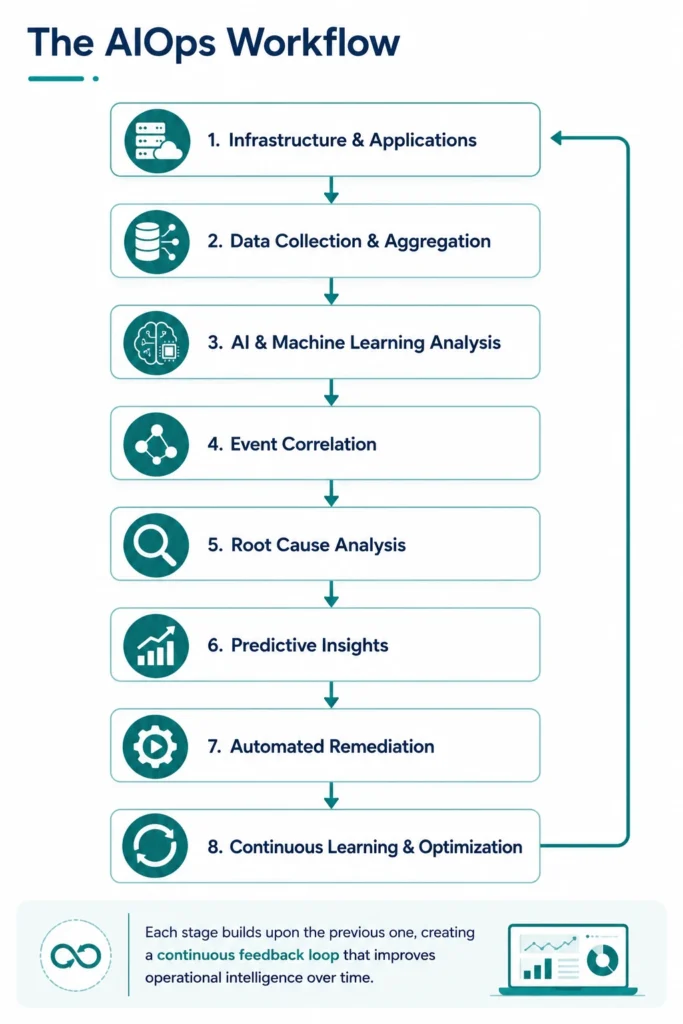
Data Collection and Aggregation
Everything in AIOps begins with data.
Modern enterprise environments generate massive volumes of operational information every second.
Typical data sources include:
- Server logs
- Network devices
- Cloud platforms
- Containers
- Databases
- Applications
- APIs
- Security systems
- ITSM platforms
- User activity
- Infrastructure metrics
Unlike traditional monitoring tools that analyze systems individually, AIOps aggregates information from across the entire IT ecosystem into a centralized platform.
This unified view enables AI models to understand relationships between different infrastructure components rather than treating every alert independently.
Why It Matters
Without centralized data collection:
- Events remain isolated.
- Root causes become difficult to identify.
- Incident response slows dramatically.
Comprehensive data ingestion lays the foundation for intelligent IT operations.
Event Correlation and Noise Reduction
One of the biggest frustrations for IT operations teams is alert overload.
A single infrastructure issue can generate hundreds—or even thousands—of alerts across different monitoring tools.
For example, a failed database server may trigger notifications from:
- Application monitoring
- Network monitoring
- Server monitoring
- API gateways
- Load balancers
- End-user monitoring tools
Instead of overwhelming engineers with duplicate alerts, AIOps intelligently groups related events into a single incident.
Benefits
✔ Eliminates duplicate alerts
✔ Reduces alert fatigue
✔ Prioritizes business-critical incidents
✔ Improves operational efficiency
Engineers spend less time sorting notifications and more time resolving actual issues.
Intelligent Anomaly Detection
Traditional monitoring depends on predefined thresholds.
For example:
- CPU > 90%
- Memory > 80%
- Disk Usage > 85%
While simple, these rules often generate false alarms or fail to detect subtle performance issues.
AIOps takes a different approach.
Using Machine Learning, it continuously learns what “normal” looks like for every application, server, and business service.
Rather than relying on static thresholds, it identifies unusual behavior based on historical patterns.
Example
Instead of flagging every increase in CPU usage, AIOps understands that:
- High CPU during month-end processing is expected.
- High CPU at 3 AM on a Sunday is unusual.
This adaptive intelligence significantly improves anomaly detection accuracy.
Root Cause Analysis
Finding the true cause of an outage is often more difficult than detecting the outage itself.
Traditional troubleshooting involves manually reviewing:
- Logs
- Dashboards
- Tickets
- Infrastructure dependencies
- Network paths
This process may take hours.
AIOps dramatically shortens investigation time by automatically correlating infrastructure events.
Example
Rather than identifying:
- Database failure
- API errors
- Slow application response
as three separate issues,
AIOps recognizes that all three originate from a single database storage failure.
This allows engineers to focus immediately on the underlying problem instead of investigating multiple symptoms.
Organizations implementing mature IT service management solutions often integrate AIOps with incident management workflows to accelerate root cause analysis and reduce Mean Time to Resolution (MTTR).
Predictive Analytics
Perhaps the most transformative capability of AIOps is prediction.
Instead of asking:
“What went wrong?”
AIOps asks:
“What is likely to go wrong next?”
By analyzing historical trends and real-time telemetry, AI models forecast potential failures before they affect business operations.
Examples include:
- Storage capacity running out
- Memory exhaustion
- Database performance degradation
- Network congestion
- Hardware failures
- Service latency
Business Value
Predictive analytics enables IT teams to:
- Prevent outages
- Improve capacity planning
- Reduce emergency maintenance
- Optimize infrastructure investments
IT operations become proactive rather than reactive.
Automated Remediation
Modern AIOps platforms don’t stop at prediction.
They can automatically execute predefined remediation workflows without waiting for human intervention.
Examples include:
- Restarting failed services
- Scaling cloud resources
- Restarting virtual machines
- Clearing temporary storage
- Creating incident tickets
- Notifying support teams
- Triggering backup systems
This creates a self-healing IT environment capable of resolving many operational issues automatically.
Example Workflow
Performance Issue Detected
│
▼
AI Identifies Root Cause
│
▼
Automation Triggered
│
▼
Restart Service
│
▼
Validate Recovery
│
▼
Close Incident Automatically
The result is significantly faster service restoration with minimal manual effort.
Core Components of an Enterprise AIOps Platform
Although vendors implement AIOps differently, most enterprise platforms share a common architecture.
|
Component |
Primary Function |
|
Data Ingestion Layer |
Collects logs, metrics, events, and traces |
|
Big Data Platform |
Stores and processes operational data |
|
Machine Learning Engine |
Detects anomalies and predicts failures |
|
Event Correlation Engine |
Groups related incidents |
|
Analytics Dashboard |
Visualizes infrastructure health |
|
Automation Engine |
Executes remediation workflows |
|
ITSM Integration |
Creates, updates, and closes incidents |
|
Reporting Module |
Tracks KPIs and operational performance |
Each component contributes to a closed-loop operational model that continuously improves over time.
Business Benefits of AIOps
Organizations adopting AIOps report on measurable improvements across multiple operational areas.
Faster Incident Resolution
Automated correlation and root cause analysis dramatically reduce investigation time.
Reduced Operational Costs
Automation minimizes repetitive manual work, allowing IT teams to focus on higher-value initiatives.
Higher Infrastructure Availability
Predictive monitoring helps prevent outages before they impact users.
Better Capacity Planning
Historical analytics improve infrastructure utilization while reducing unnecessary cloud spending.
Improved Employee Productivity
Engineers spend less time responding to alerts and more time driving innovation.
Stronger Customer Experience
Reliable digital services translate directly into higher customer satisfaction and stronger business continuity.
Organizations implementing ITSM consulting services often combine AIOps with automation and service management to maximize these operational benefits.
Real-World AIOps Use Cases
AIOps is delivering measurable value across virtually every industry.
|
Industry |
Example Use Cases |
|
Banking |
Fraud detection, payment monitoring, transaction analytics |
|
Healthcare |
Patient system monitoring, medical device analytics, EHR performance |
|
Retail |
Website availability, inventory systems, customer experience monitoring |
|
Telecommunications |
Network optimization, bandwidth prediction, outage prevention |
|
Manufacturing |
Predictive maintenance, IoT analytics, production monitoring |
|
Logistics |
Fleet monitoring, warehouse optimization, supply chain visibility |
As digital ecosystems continue to expand, these use cases will become increasingly sophisticated.
Organizations interested in adopting AI across service management can also explore Benefits & Challenges of AI in ITSM, which explains how AI is transforming IT support, service delivery, and operational efficiency.
Best Practices for Successful AIOps Adoption
Enterprises that achieve the greatest value from AIOps typically follow a structured implementation approach.
Recommended Best Practices
- Begin with clearly defined business objectives.
- Integrate data from all critical systems.
- Standardize monitoring across environments.
- Automate low-risk operational tasks first.
- Continuously train AI models using operational data.
- Measure success using operational KPIs.
- Integrate AIOps with ITSM platforms for closed-loop incident management.
- Encourage collaboration between IT operations, security, and development teams.
Organizations should treat AIOps as a continuous improvement initiative rather than a one-time technology deployment.
Challenges of Implementing AIOps (And How to Overcome Them)
While AIOps offers significant advantages, implementing it successfully requires more than deploying an AI-powered platform. Organizations must address technical, operational, and cultural challenges to fully realize its potential.
Understanding these challenges early helps enterprises build a sustainable roadmap for intelligent IT operations.
Poor Data Quality
Artificial Intelligence is only as effective as the data it receives.
If operational data is incomplete, inconsistent, or inaccurate, AIOps platforms struggle to produce meaningful insights.
Common data challenges include:
- Duplicate logs
- Missing telemetry
- Inconsistent data formats
- Disconnected monitoring tools
- Incomplete configuration data
Best Practices
Organizations should:
- Standardize data collection across platforms.
- Eliminate duplicate monitoring tools.
- Normalize log formats.
- Continuously validate telemetry quality.
- Build centralized observability pipelines.
Better data quality leads to better AI decisions.
Siloed IT Operations
Many enterprises still operate separate teams for:
- Infrastructure
- Networks
- Cloud
- Security
- Applications
- Service Desk
Each team often uses different monitoring platforms and workflows.
Without collaboration, AIOps cannot correlate events across the entire technology ecosystem.
Solution
Adopt unified operational processes supported by mature IT service management consulting practices.
Cross-functional collaboration enables:
✔ Faster incident resolution
✔ Better root cause analysis
✔ Improved service visibility
✔ Higher operational efficiency
Legacy Infrastructure
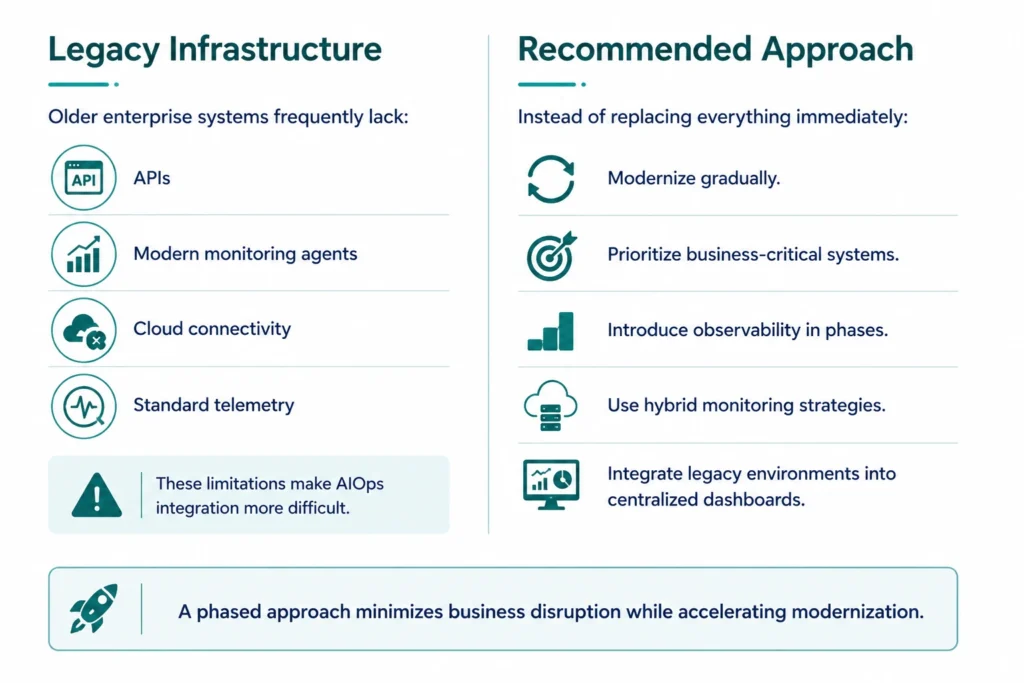
Older enterprise systems frequently lack:
- APIs
- Modern monitoring agents
- Cloud connectivity
- Standard telemetry
These limitations make AIOps integration more difficult.
Recommended Approach
Instead of replacing everything immediately:
- Modernize gradually.
- Prioritize business-critical systems.
- Introduce observability in phases.
- Use hybrid monitoring strategies.
- Integrate legacy environments into centralized dashboards.
A phased approach minimizes business disruption while accelerating modernization.
Skill Gaps
Successful AIOps initiatives require expertise across multiple disciplines, including:
- Artificial Intelligence
- Machine Learning
- IT Operations
- Cloud Computing
- Automation
- Data Analytics
Many organizations struggle to find professionals with all these capabilities.
How to Address the Skills Gap
- Invest in employee training.
- Build cross-functional teams.
- Partner with experienced ITSM consulting services providers.
- Encourage knowledge sharing between operations, cloud, and security teams.
Technology alone cannot drive transformation—people remain essential.
Over-Reliance on Automation
Automation should support IT professionals—not replace operational governance.
Organizations sometimes expect AIOps to solve every operational challenge automatically.
In reality, successful AIOps combines:
- Human expertise
- AI-driven intelligence
- Governance
- Automation
- Continuous improvement
Maintaining human oversight ensures business-critical decisions remain aligned with organizational objectives.
A Step-by-Step Roadmap for Implementing AIOps
Organizations that approach AIOps strategically are more likely to achieve long-term success than those attempting large-scale implementations all at once.
A phased roadmap helps reduce complexity while demonstrating measurable value.
Assess Current IT Environment
│
▼
Identify High-Value Use Cases
│
▼
Consolidate Data Sources
│
▼
Deploy AIOps Platform
│
▼
Train AI Models
│
▼
Integrate with ITSM Platform
│
▼
Automate Low-Risk Workflows
│
▼
Measure KPIs & Optimize
│
▼
Scale Across the Enterprise
Working with experienced IT service management consulting experts helps organizations accelerate adoption while avoiding common implementation pitfalls.
Measuring the Success of AIOps
The value of AIOps should be measured using business-focused performance indicators rather than technology metrics alone.
Key Performance Indicators
|
KPI |
Business Impact |
|
Mean Time to Detect (MTTD) |
Faster incident identification |
|
Mean Time to Resolve (MTTR) |
Improved operational efficiency |
|
Alert Reduction Rate |
Lower alert fatigue |
|
Incident Prediction Accuracy |
Better proactive management |
|
Automation Success Rate |
Higher operational productivity |
|
System Availability |
Improved business continuity |
|
SLA Compliance |
Better service delivery |
|
Infrastructure Utilization |
Optimized resource usage |
|
Customer Satisfaction (CSAT) |
Enhanced user experience |
Tracking these KPIs enables continuous improvement while demonstrating the business value of AIOps initiatives.
The Future of AIOps
Artificial Intelligence continues to redefine how enterprise IT operations are managed.
Over the coming years, AIOps will evolve beyond intelligent monitoring into fully autonomous IT operations.
Several emerging trends are already shaping this transformation.
Autonomous IT Operations
Future platforms will automatically:
- Detect issues
- Diagnose root causes
- Execute remediation
- Validate recovery
- Learn from every incident
Human intervention will become necessary only for complex business decisions.
Generative AI for IT Operations
Large Language Models (LLMs) will make AIOps more conversational.
IT teams will be able to ask questions such as:
- Why did application latency increase?
- Which service is affecting customer experience?
- Recommend the best remediation plan.
AI will provide contextual, data-driven answers within seconds.
Unified Operations
Rather than operating independently, future platforms will integrate:
- AIOps
- ITSM
- SecOps
- FinOps
- CloudOps
- DevOps
This creates a single operational ecosystem capable of managing performance, cost, security, and service delivery together.
Predictive Business Operations
AIOps will increasingly connect technical events with business outcomes.
For example:
- Predicting revenue impact before an outage occurs.
- Identifying customer-facing risks automatically.
- Forecasting infrastructure demand based on business growth.
IT operations will become a strategic business enabler rather than simply a support function.
Why Choose MicroGenesis for AIOps and IT Operations Transformation?
Successfully implementing AIOps requires more than selecting the right technology platform. Organizations need a strategic partner capable of aligning AI, automation, cloud infrastructure, and IT service management with business objectives.
As a trusted provider of IT service management services, MicroGenesis helps enterprises modernize IT operations through intelligent automation, predictive analytics, and operational excellence.
Our Expertise Includes
ITSM Consulting Services
We assess your operational maturity, identify improvement opportunities, and develop tailored strategies that align with your digital transformation goals.
Intelligent IT Operations
Our experts help organizations implement:
- AIOps platforms
- AI-powered observability
- Incident automation
- Predictive monitoring
- Intelligent event correlation
Infrastructure & Cloud Optimization
We support:
- Multi-cloud operations
- Infrastructure modernization
- Performance optimization
- Capacity planning
End-to-End ITSM Solutions
Our comprehensive IT service management solutions include:
- Incident Management
- Problem Management
- Change Enablement
- Asset Management
- Service Request Management
- Knowledge Management
By integrating AIOps with mature ITSM practices, we help organizations reduce operational complexity, improve service reliability, and accelerate digital transformation.
AIOps Readiness Checklist
Before implementing AIOps, ensure your organization is prepared in the following areas:
|
Checklist |
Status |
|
Centralized monitoring in place |
☐ |
|
High-quality operational data available |
☐ |
|
Cloud and on-premises visibility established |
☐ |
|
ITSM platform integrated |
☐ |
|
Automation workflows identified |
☐ |
|
Governance framework defined |
☐ |
|
Executive sponsorship secured |
☐ |
|
KPIs established |
☐ |
|
Cross-functional teams aligned |
☐ |
|
Continuous improvement process implemented |
☐ |
Organizations that address these foundational elements are significantly more likely to achieve successful AIOps adoption.
Conclusion
As enterprise IT environments continue to grow in scale and complexity, traditional monitoring and reactive operations are no longer sufficient. Organizations need intelligent systems capable of analyzing massive volumes of operational data, predicting issues before they occur, and automating routine tasks to maintain service reliability.
AIOps represents the next evolution of IT operations by combining Artificial Intelligence, Machine Learning, big data analytics, and automation into a unified operational framework. It empowers IT teams to reduce alert fatigue, accelerate incident resolution, improve infrastructure availability, and deliver exceptional digital experiences.
However, realizing the full value of AIOps requires more than deploying AI-powered tools. Organizations must establish strong data foundations, integrate AIOps with IT service management services, adopt mature governance practices, and continuously optimize operational workflows. Partnering with experienced ITSM consulting services providers ensures a structured implementation approach that aligns technology investments with business objectives.
At MicroGenesis, we help enterprises transform traditional IT operations into intelligent, resilient, and future-ready ecosystems through comprehensive IT service management consulting, AIOps implementation, cloud modernization, and automation services. Whether you’re beginning your AIOps journey or expanding enterprise-wide intelligent operations, our experts provide the strategy, technology, and support needed to drive measurable business outcomes.
The future of IT operations is predictive, automated, and self-healing—and AIOps is the foundation that makes it possible.


