


In today’s hyper-competitive business environment, organizations are under constant pressure to improve efficiency, reduce operational costs, and deliver exceptional customer experiences. While digital transformation remains a top strategic priority, many businesses still rely on manual, repetitive processes that consume valuable employee time, increase operational expenses, and create opportunities for human error.
This is where Robotic Process Automation (RPA) has emerged as a game-changing technology. By automating rule-based, repetitive tasks, RPA enables organizations to streamline operations, improve accuracy, strengthen compliance, and free employees to focus on high-value strategic initiatives.
From banking and financial services to healthcare, manufacturing, retail, logistics, and government, businesses worldwide are embracing automation to accelerate productivity and remain competitive. In particular, Robotic Process Automation in India has witnessed significant growth as enterprises invest in intelligent automation to modernize operations and build future-ready digital workplaces.
However, implementing RPA successfully requires much more than purchasing an automation platform or deploying a few software bots. Many organizations achieve promising pilot results but struggle to scale automation across departments due to poor planning, inadequate governance, technology limitations, or a lack of internal expertise.
This is why choosing the right RPA services company becomes one of the most important decisions in your automation journey.
A trusted RPA service provider does far more than develop bots. They help organizations identify automation opportunities, select the right technology, establish governance, integrate automation into existing business systems, measure ROI, and continuously optimize automation initiatives for long-term success.
In this comprehensive guide, we’ll explore how to choose the right RPA consulting services partner, the key factors to evaluate, common mistakes to avoid, and why partnering with an experienced automation expert like MicroGenesis can significantly accelerate your digital transformation journey.
Why Choosing the Right RPA Service Provider Matters
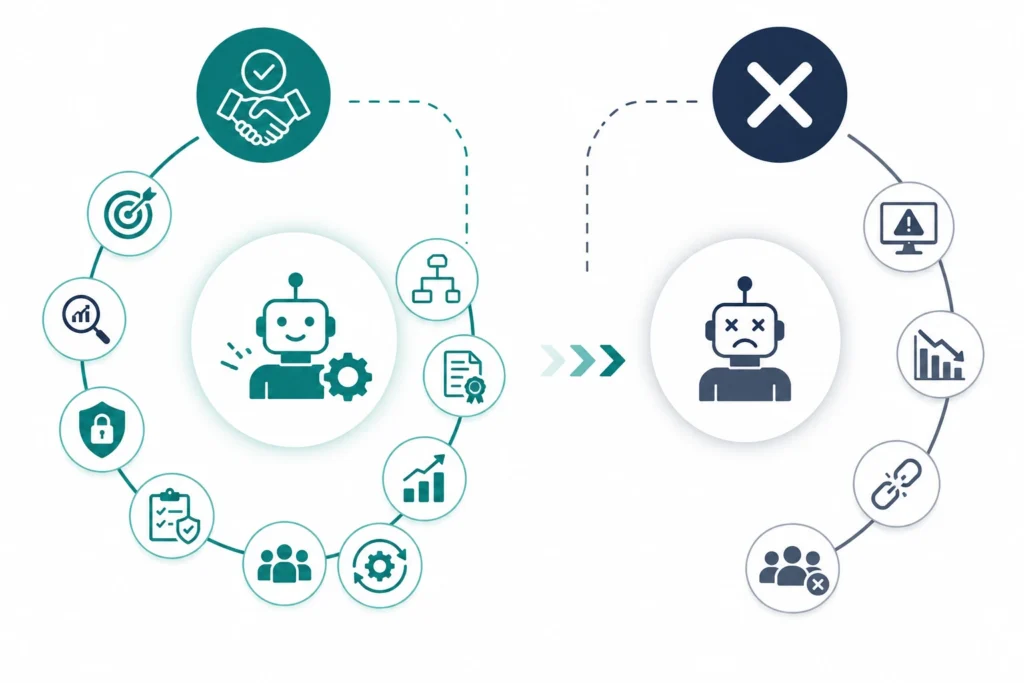
Robotic Process Automation projects often begin with a simple objective—automate repetitive work. Yet many organizations quickly discover that enterprise automation is far more complex than deploying software bots.
Successful automation requires:
- Strategic planning
- Process discovery
- Technology selection
- Governance
- Security
- Compliance
- Change management
- Employee adoption
- Continuous optimization
Without these elements, automation initiatives frequently stall after a few successful pilots.
According to industry research, many RPA programs fail to scale because organizations focus exclusively on technology while overlooking process maturity, governance, and organizational readiness.
An experienced RPA implementation services partner helps eliminate these risks by combining technical expertise with business process knowledge.
What Does an RPA Service Provider Actually Do?
Many businesses assume an RPA provider simply develops automation bots.
In reality, leading robotic process automation service providers support organizations throughout the entire automation lifecycle.
| Phase | How an RPA Service Provider Helps |
| Process Discovery | Identifies automation opportunities with the highest ROI |
| Strategy | Develops an enterprise automation roadmap aligned with business goals |
| Technology Selection | Recommends the most suitable RPA platform based on business needs |
| Bot Development | Designs secure, scalable, and reusable automation workflows |
| Testing | Validates automation accuracy, reliability, and business continuity |
| Deployment | Implements bots with minimal disruption to business operations |
| Governance | Establishes security, compliance, and operational standards |
| Training | Upskills employees and automation teams |
| Support | Provides ongoing monitoring, maintenance, and optimization |
The best providers become long-term automation partners rather than short-term implementation vendors.
1. Define Your Automation Vision Before Selecting a Provider
Before evaluating vendors, organizations should first define what they expect automation to achieve.
An RPA partner can strengthen your strategy—but they cannot define your business objectives for you.
Broadly speaking, organizations fall into two categories.
Tactical Automation
A tactical approach focuses on improving operational efficiency through automation of repetitive, rules-based processes.
Common examples include:
- Invoice processing
- Data entry
- Employee onboarding
- Purchase order creation
- Report generation
- Claims processing
- Email routing
The primary objectives are:
- Reduce costs
- Eliminate manual errors
- Increase productivity
- Improve processing speed
This approach typically delivers quick wins and measurable ROI within a relatively short timeframe.
Strategic Automation
Strategic automation extends beyond repetitive tasks to support enterprise-wide digital transformation.
Organizations combine RPA with technologies such as:
- Artificial Intelligence (AI)
- Machine Learning (ML)
- Intelligent Document Processing (IDP)
- Optical Character Recognition (OCR)
- Natural Language Processing (NLP)
- Process Mining
- Predictive Analytics
Instead of automating isolated tasks, businesses redesign end-to-end workflows to create intelligent, self-optimizing processes.
Strategic automation focuses on:
- Customer experience
- Hyperautomation
- Digital-first operations
- Business agility
- Enterprise scalability
Organizations pursuing intelligent automation should also explore AI + RPA: A Growth Strategy for Intelligent Enterprises.
2. Evaluate Industry Expertise
Not every automation challenge is the same.
Automating invoice processing for a manufacturing company differs significantly from automating patient records in healthcare or loan approvals in banking.
This is why industry expertise should be one of the first evaluation criteria when selecting robotic process automation consulting services.
Ask potential providers:
- Have they worked in your industry?
- Do they understand your regulatory environment?
- Can they demonstrate measurable business outcomes?
- Do they understand your core business processes?
- Have they implemented automation at enterprise scale?
Industry-specific knowledge reduces implementation risk while improving long-term success.
Examples of Industry-Specific RPA Applications
| Industry | Common Automation Opportunities |
| Banking & Financial Services | Loan processing, KYC, AML compliance, reconciliations |
| Insurance | Claims processing, underwriting, policy administration |
| Healthcare | Patient onboarding, appointment scheduling, billing |
| Manufacturing | Procurement, inventory management, production reporting |
| Retail | Order processing, returns management, customer service |
| Logistics | Shipment tracking, invoice validation, warehouse operations |
Organizations interested in manufacturing automation can also read Robotic Process Automation in Manufacturing.
3. Assess Technology Partnerships and Platform Expertise
Choosing the right automation platform is just as important as selecting the right consulting partner.
A reliable RPA services company should possess expertise across multiple automation platforms rather than recommending a single product for every use case.
Leading RPA technologies include:
- UiPath
- Automation Anywhere
- Blue Prism
- Microsoft Power Automate
- Open-source RPA platforms
Rather than promoting a preferred vendor, experienced RPA consulting services providers evaluate your existing IT environment, business processes, scalability requirements, and budget before recommending the most suitable platform.
When evaluating technology expertise, ask questions such as:
- Are they certified implementation partners?
- Do they provide platform-neutral recommendations?
- Can they integrate RPA with ERP, CRM, AI, OCR, and legacy applications?
- Do they support cloud, on-premises, and hybrid deployments?
- Can they help build an automation roadmap beyond the initial implementation?
A technology-first mindset often leads to short-term success but long-term limitations. A business-first approach ensures automation continues to evolve alongside organizational goals.
Organizations evaluating automation partners should also explore How to Choose a Service Provider to Fulfill Your RPA Vision for additional considerations and best practices.
4. Look for End-to-End RPA Implementation Services
One of the biggest mistakes organizations make is selecting a vendor that focuses only on bot development. Successful automation requires much more than writing scripts—it demands a structured approach that spans strategy, implementation, governance, optimization, and long-term support.
The best RPA implementation services providers offer comprehensive lifecycle support that ensures automation initiatives continue to deliver value long after deployment.
A Mature RPA Lifecycle
| Phase | Business Value |
| Process Discovery & Assessment | Identify high-value automation opportunities and estimate ROI. |
| Solution Design | Create scalable automation architectures aligned with business processes. |
| Bot Development | Build reusable, secure, and efficient automation workflows. |
| Testing & Validation | Ensure bots perform accurately under real-world conditions. |
| Deployment | Roll out automation with minimal disruption to business operations. |
| Support & Maintenance | Monitor bots, resolve issues, and ensure continuous availability. |
| Continuous Optimization | Analyze performance and improve automation over time. |
A provider that supports every phase of the automation lifecycle can help organizations transition from isolated automation projects to enterprise-wide intelligent automation.
Testing is particularly important because even small automation failures can disrupt critical business processes. Organizations can learn more about building reliable automation by exploring RPA Testing Framework: The Complete Guide.
5. Evaluate Governance, Security, and Compliance
As automation expands across departments, governance becomes increasingly important. Without proper controls, organizations may experience bot sprawl, inconsistent processes, security vulnerabilities, and compliance challenges.
An experienced RPA service provider should help establish a governance framework that ensures automation remains secure, manageable, and aligned with organizational policies.
Governance Checklist
A mature automation partner should provide:
- RPA Center of Excellence (CoE) setup
- Bot lifecycle management
- Role-based access control (RBAC)
- Audit trails and activity logging
- Version control and change management
- Compliance documentation
- Security best practices
- Disaster recovery planning
For organizations operating in regulated industries such as banking, healthcare, life sciences, and manufacturing, governance is essential for meeting standards such as GDPR, HIPAA, SOX, and industry-specific regulations.
Rather than treating governance as an afterthought, leading robotic process automation consulting services providers integrate it into every phase of implementation.
6. Choose a Partner That Can Scale with Your Business
Many automation projects deliver impressive results during pilot phases but fail to scale across the organization.
Why?
Because enterprise automation requires standardized architectures, reusable components, centralized governance, and long-term planning.
When evaluating robotic process automation service providers, ask questions such as:
- Can they support hundreds of bots?
- Do they offer reusable automation frameworks?
- Can they integrate AI and machine learning?
- Do they support cloud, hybrid, and on-premises environments?
- Can they automate processes across multiple business units?
Future-ready providers don’t simply automate today’s processes—they prepare organizations for tomorrow’s automation needs.
Characteristics of a Scalable Automation Strategy
✔ Modular bot architecture
✔ Reusable workflows
✔ Centralized monitoring
✔ AI integration
✔ API-first design
✔ Cloud-ready deployment
✔ Enterprise governance
Organizations that build scalability into their automation strategy are better positioned to adopt hyperautomation and intelligent business processes in the future.
Businesses looking to maximize long-term automation success should also explore Robotic Process Automation Best Practices.
7. Assess Change Management and Employee Adoption
Technology alone does not guarantee successful automation.
One of the most overlooked aspects of RPA implementation is preparing employees for change.
Automation often transforms daily workflows, introduces new responsibilities, and changes how teams interact with business systems. Without effective communication and training, organizations may face resistance, reduced adoption, and lower ROI.
An experienced RPA consulting services partner should help organizations manage both the technical and human sides of automation.
Effective Change Management Includes
- Executive sponsorship
- Employee awareness programs
- Business user training
- Developer training
- Administrator certification
- Center of Excellence (CoE) enablement
- Documentation and knowledge transfer
- Continuous learning initiatives
Rather than replacing employees, modern automation empowers teams by eliminating repetitive work and allowing them to focus on higher-value activities such as innovation, customer engagement, and strategic decision-making.
8. Demand Transparency in ROI Measurement
One of the first questions leadership asks after investing in automation is:
“What business value are we actually achieving?”
Leading RPA services companies answer this question with measurable data rather than assumptions.
Your automation partner should define Key Performance Indicators (KPIs) before implementation begins.
Common RPA Success Metrics
| KPI | Business Impact |
| Processing Time | Faster service delivery |
| Cost Savings | Lower operational expenses |
| Accuracy | Reduced manual errors |
| Employee Productivity | Higher-value work allocation |
| Compliance Rate | Improved audit readiness |
| Customer Satisfaction | Better service quality |
| Bot Utilization | Increased automation efficiency |
Advanced providers also use process mining, analytics dashboards, and real-time reporting to continuously identify new optimization opportunities.
Organizations interested in measuring automation maturity and business outcomes should also explore RPA to Accelerate Business Growth.
9. Review Customer Success Stories and Industry References
Past performance is often the strongest indicator of future success.
Before selecting an RPA service provider, review customer case studies, references, and implementation success stories.
Look beyond technical achievements and evaluate measurable business outcomes.
Ask Providers Questions Like
- Have they implemented RPA in your industry?
- Can they demonstrate enterprise-scale deployments?
- What measurable ROI have clients achieved?
- Do they provide long-term support after implementation?
- Can they share customer references?
Strong Case Studies Typically Highlight
- Reduction in manual effort
- Faster processing times
- Improved compliance
- Cost savings
- Increased productivity
- Enhanced customer experience
- Enterprise-wide automation adoption
Providers with proven experience are far more likely to deliver successful outcomes than those relying solely on technical certifications.
Additionally, organizations evaluating automation opportunities can gain valuable insights from RPA Use Cases Across Industries, which showcases practical applications of robotic process automation in different business functions.
10. Why MicroGenesis Is the Right RPA Services Company for Your Business
Selecting an automation partner isn’t simply about technical expertise—it’s about finding a team that understands your business objectives, industry challenges, and long-term digital transformation goals.
At MicroGenesis, we believe Robotic Process Automation should deliver measurable business outcomes, not just automate repetitive tasks. As a trusted RPA services company, we combine deep process expertise, intelligent automation capabilities, and industry knowledge to help organizations transform operations, improve productivity, and build scalable automation ecosystems.
Whether you’re beginning your automation journey or scaling enterprise-wide initiatives, our RPA consulting services help you identify the right opportunities, select the best technologies, and implement automation strategies that deliver sustainable business value.
Our End-to-End RPA Services
MicroGenesis offers comprehensive RPA implementation services designed to support organizations throughout every stage of their automation journey.
Process Discovery & Assessment
Successful automation begins with identifying the right processes.
Our consultants analyze your existing workflows to determine:
- High-volume repetitive processes
- Rule-based business activities
- Automation feasibility
- Expected ROI
- Process standardization opportunities
This ensures automation investments focus on areas that generate the highest business value.
Automation Strategy & Consulting
Every organization has unique business objectives.
Our robotic process automation consulting services help define an automation roadmap aligned with your:
- Business goals
- Digital transformation initiatives
- IT landscape
- Compliance requirements
- Budget and scalability objectives
Rather than implementing bots in isolation, we build automation strategies that support long-term enterprise growth.
Multi-Platform Expertise
Every business has different automation requirements.
Our specialists work across leading automation platforms, including:
- UiPath
- Automation Anywhere
- Microsoft Power Automate
- Blue Prism
- Intelligent Automation solutions
We provide platform-neutral recommendations based on your existing infrastructure, operational needs, and future scalability—not vendor preferences.
Enterprise RPA Implementation
Our RPA implementation services follow proven best practices to ensure secure, scalable, and reliable automation deployments.
Our implementation methodology includes:
- Solution architecture
- Bot development
- Integration with enterprise applications
- Testing and validation
- Deployment planning
- Production rollout
- Post-deployment support
This structured approach minimizes implementation risks while accelerating automation adoption.
Intelligent Automation Integration
Modern automation extends beyond traditional RPA.
MicroGenesis helps organizations integrate automation with:
- Artificial Intelligence (AI)
- Machine Learning (ML)
- Intelligent Document Processing (IDP)
- OCR
- Natural Language Processing (NLP)
- Analytics platforms
This enables businesses to move toward hyperautomation and intelligent decision-making.
Organizations interested in combining AI with automation can also explore AI + RPA: Growth Strategy for Intelligent Enterprises.
Governance, Compliance & Security
As automation scales across the enterprise, governance becomes increasingly important.
We help organizations establish:
- RPA Centers of Excellence (CoEs)
- Security policies
- Bot lifecycle management
- Audit trails
- Compliance documentation
- Access controls
- Operational governance
This ensures automation remains secure, compliant, and easy to manage.
Continuous Support & Optimization
Automation is an ongoing journey—not a one-time project.
Our managed RPA services include:
- Bot monitoring
- Performance optimization
- Incident management
- Platform upgrades
- Process enhancements
- Continuous improvement
By continuously measuring performance, we help organizations maximize long-term ROI from their automation investments.
Why Organizations Choose MicroGenesis
Organizations across industries trust MicroGenesis because we combine technical excellence with business-focused consulting.
Our Differentiators
| Capability | Business Benefit |
| Industry-Specific Expertise | Solutions tailored to your business processes and regulatory requirements |
| Platform-Neutral Consulting | Recommendations based on business needs rather than vendor preferences |
| End-to-End Automation Services | Complete support from strategy through optimization |
| Compliance-First Approach | Automation aligned with governance and regulatory standards |
| Scalable Architecture | Solutions designed for enterprise-wide automation |
| Long-Term Partnership | Continuous support, training, and automation maturity planning |
Whether you’re looking for a reliable RPA service provider, enterprise-grade robotic process automation consulting services, or scalable RPA implementation services, MicroGenesis helps organizations accelerate automation while minimizing operational risks.
Common Mistakes to Avoid When Selecting an RPA Partner
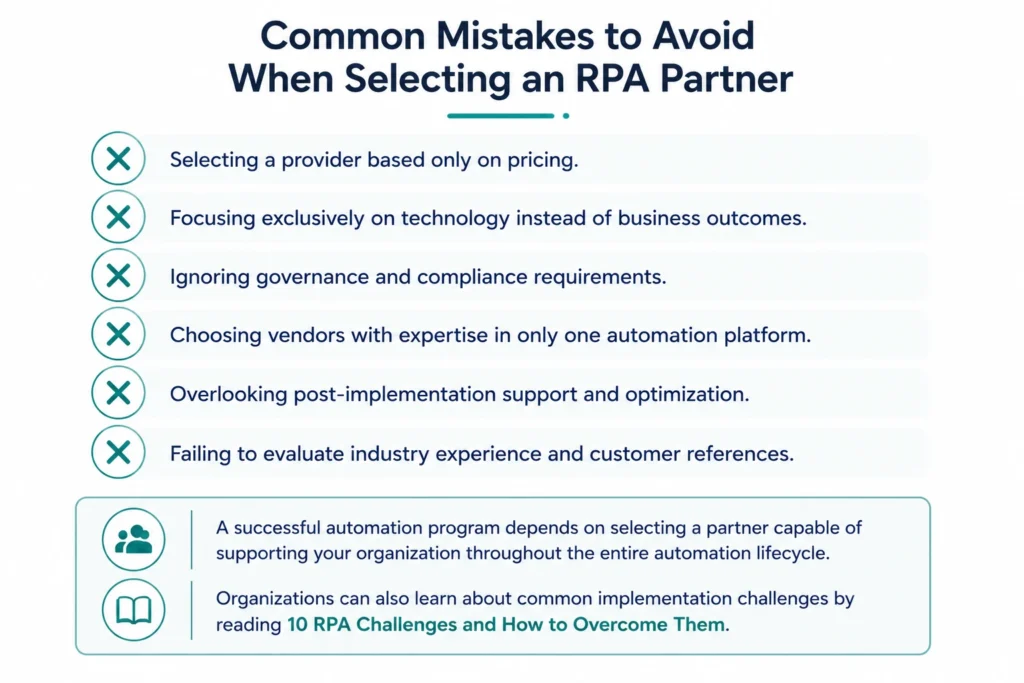
Organizations can also learn about common implementation challenges by reading 10 RPA Challenges and How to Overcome Them.
Checklist: How to Evaluate an RPA Service Provider
Before making your final decision, use this checklist to compare potential partners.
| Evaluation Criteria | ✔ |
| Industry expertise | ☐ |
| Certified RPA professionals | ☐ |
| Multi-platform expertise | ☐ |
| End-to-end implementation capabilities | ☐ |
| AI and intelligent automation expertise | ☐ |
| Governance and compliance framework | ☐ |
| Enterprise integration experience | ☐ |
| Training and change management | ☐ |
| Managed support services | ☐ |
| Proven customer success stories | ☐ |
| Transparent ROI reporting | ☐ |
| Scalability and future-readiness | ☐ |
The more boxes your chosen provider checks, the greater your chances of building a successful and sustainable automation program.
Conclusion
Robotic Process Automation has evolved far beyond simple task automation. Today, it serves as a strategic driver of operational excellence, digital transformation, and business agility. However, realizing its full potential depends not only on selecting the right technology but also on partnering with the right RPA services company.
A trusted RPA service provider should bring more than technical expertise. They should understand your industry, design automation strategies aligned with business objectives, establish governance frameworks, and support continuous improvement as your automation initiatives mature. From process discovery and platform selection to implementation, optimization, and enterprise-wide scaling, the right partner plays a critical role in turning automation into a long-term competitive advantage.
At MicroGenesis, we combine deep industry expertise, proven RPA consulting services, and end-to-end RPA implementation services to help organizations automate with confidence. Whether you’re beginning your automation journey or expanding intelligent automation across the enterprise, our experts work alongside your teams to deliver secure, scalable, and measurable business outcomes.
As automation continues to evolve with AI, analytics, and hyperautomation, businesses that invest in the right strategy and the right partner will be best positioned to improve efficiency, enhance customer experiences, and accelerate sustainable growth.


